
Carbon Fiber Kart Frame Practical Guide 2025
In the modern kart manufacturing field, carbon fiber composites are leading a lightweight revolution. This advanced material, originating from the aerospace sector, with its unique performance advantages, brings an unprecedented weight-to-thrust ratio and body rigidity to karts, completely redefining the performance boundaries of small-scale racing vehicles.
Directory
Carbon Fiber vs. Metal Frame Comparison Table …
Lightweight and Weight-to-Thrust Ratio: A Performance Leap …
Excellent Body Rigidity: The Cornerstone of Precise Control …
Powerful Corrosion Resistance: Extending Service Life …
Modular Design: Infinite Possibilities …
Outstanding Performance on Various Road Conditions …
Conclusion and Frame Selection Guide …
High Search Volume Keywords Table …
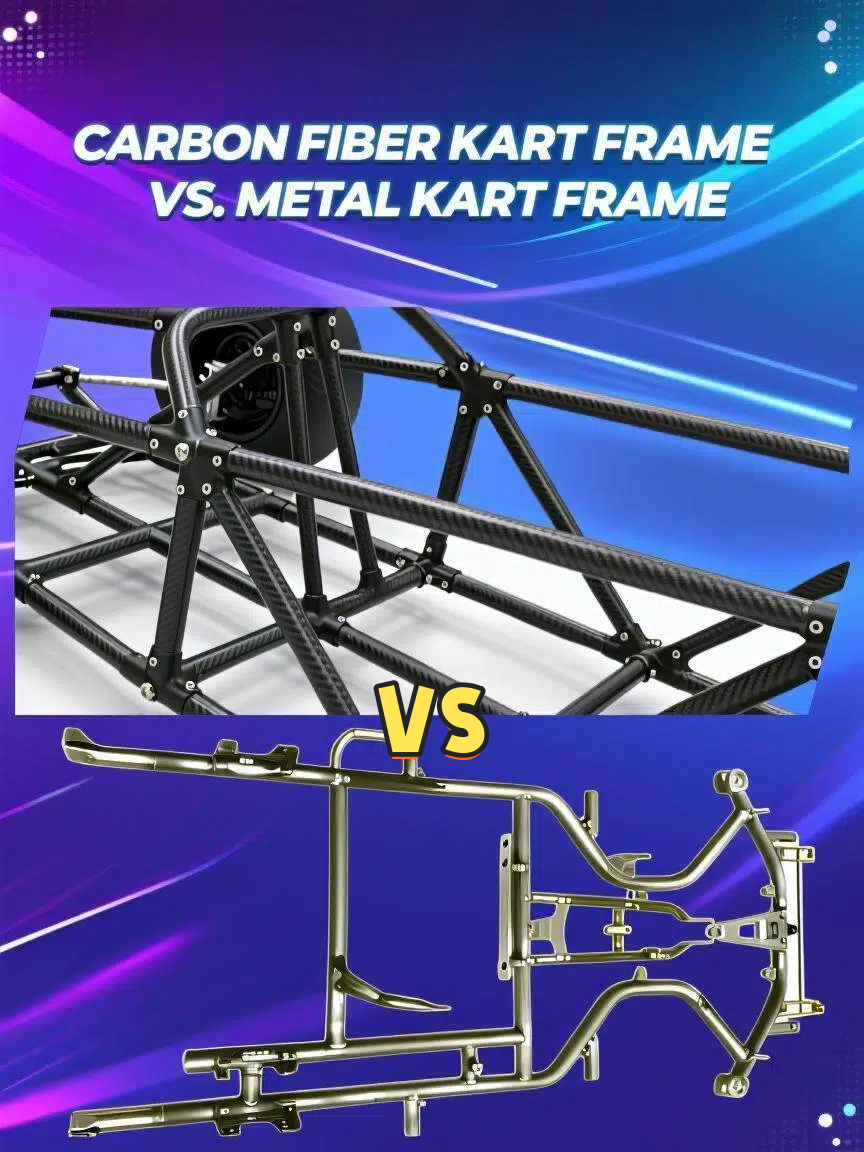
Carbon Fiber vs. Metal Frame Comparison Table
| Comparison Dimension | Carbon Fiber Frame | Metal Frame (Using Aluminum Alloy as Example) |
| Weight & Weight-to-Thrust Ratio | Extremely light, density approx. 1.3-1.6g/cm³, significantly lighter than metals. Weight reduction effect is 20%-40% higher than aluminum alloy, greatly improving acceleration and handling. | Relatively heavy, aluminum alloy density approx. 2.7g/cm³. While weight can be reduced through technology, it’s hard to reach carbon fiber levels in high-end applications. |
| Rigidity & Handling | High strength and high rigidity. Specific modulus is much higher than aluminum alloy, with minimal deformation under stress, providing extremely precise handling feedback. | Relatively high rigidity, meeting most needs. But achieving high rigidity might limit tube shapes. |
| Corrosion Resistance & Lifespan | Excellent. Good fatigue resistance and corrosion resistance, suitable for harsh environments, long service life. | Average. Rust prevention is needed; durability in humid or corrosive environments is not as good as carbon fiber. |
| Design Flexibility & Modularity | High design flexibility. Can be molded integrally, easy to create complex shapes and achieve modular design, optimizing aerodynamics. | Lower design flexibility. Often relies on tube welding, shaping is relatively rigid, complex structures are difficult to achieve. |
| Cost & Repair | High production cost and purchase price; difficult and costly to repair after damage, severe cases may require replacing entire components. | Affordable price, mature manufacturing process; relatively easy and cheaper to repair after damage. |
| Impact Resistance | Anisotropic material, sensitive to impacts perpendicular to the fiber direction; damage may cause brittle fracture. | Isotropic material, better at absorbing impact energy; damage often shows visible deformation like dents first, rather than direct fracture. |
Lightweight and Weight-to-Thrust Ratio: A Performance Leap
The density of carbon fiber resin matrix composites is typically around 1.6g/cm³, which is only one-quarter that of ordinary steel and about 40% lighter than aluminum alloy. This significant weight reduction allows carbon fiber kart frames to greatly reduce weight, leading to a remarkable improvement in weight-to-thrust ratio.
In kart racing, every gram of weight reduced translates into faster acceleration and higher top speeds. Research indicates that for vehicles with identical structures, a weight difference of about 1.8 kilograms results in the heavier vehicle being nearly 60 meters behind over a 2-kilometer distance. This difference is often the key factor determining victory or defeat in kart races.
Carbon fiber is not only lightweight but also boasts a specific strength (strength-to-density ratio) that is 2 to 8 times that of ordinary steel or aluminum alloy, and a specific modulus (modulus-to-density ratio) that is 3 to 5 times higher than these traditional materials. This means that while the carbon fiber frame is significantly lighter, it can provide superior mechanical performance, making every power transfer more direct and efficient.
Excellent Body Rigidity: The Cornerstone of Precise Control
Carbon fiber kart frames achieve extremely high rigidity through precise carbon fiber layup processes. This high rigidity ensures minimal frame deformation during high-speed cornering, rapid acceleration, and emergency braking, providing the vehicle with precise handling feedback.
The anisotropic nature of carbon fiber allows engineers to perform directional reinforcement design based on the stress conditions of different parts of the frame. Layers of carbon fiber can be increased in areas requiring high rigidity, while weight can be reduced in other areas, achieving the optimal balance between rigidity and lightness.
Particularly noteworthy is that carbon fiber material provides high rigidity while also possessing excellent vibration absorption. Studies show that in vibration tests on frames of the same shape and size, an aluminum alloy frame takes 9 seconds to stop vibrating, while a carbon fiber frame takes only 2.5 seconds. This rapid vibration damping characteristic significantly improves the stability and handling of the kart on bumpy tracks.
Powerful Corrosion Resistance: Extending Service Life
Compared to traditional metal materials, carbon fiber composites exhibit excellent corrosion resistance. Carbon fiber is a graphite crystal structure formed through high-temperature graphitization treatment. This physical structure is very stable, resistant to acids, alkalis, industrial atmospheres, and other corrosive substances.
This characteristic makes carbon fiber kart frames particularly suitable for use in various environmental conditions. Whether on damp tracks or in coastal areas, they can maintain long-term stable performance without rusting issues common to metal frames. This implies that carbon fiber frames have a longer service life and better value retention.
Modular Design: Infinite Possibilities
Carbon fiber material has extremely high plasticity and can be formed into various desired shapes with no visible traces of connection on the surface. This characteristic provides broad space for the modular design of kart frames, allowing owners to flexibly adjust the vehicle configuration according to different needs.
Through precise mold manufacturing and carbon fiber layup processes, carbon fiber frames can achieve integral molding of various complex shapes. This molding capability makes the connections between modules more precise and reliable while ensuring the rigidity and lightweight of the overall structure.
Outstanding Performance on Various Road Conditions
Carbon fiber kart frames demonstrate excellent stability and rigidity under various road conditions. During high-speed straight-line driving, the high-rigidity frame ensures efficient power transfer; during sharp turns, the frame with strong torsional stiffness provides precise steering feedback; on bumpy roads, the good damping characteristics of carbon fiber effectively reduce vibration transmission.
Conclusion and Frame Selection Guide
Carbon fiber kart frames represent the perfect combination of materials science and vehicle engineering. Their ultimate lightweight characteristics bring an unparalleled weight-to-thrust ratio, while excellent body rigidity ensures precise handling performance. The outstanding corrosion resistance and modular design potential further extend their application value.
💡 How to Choose the Right Frame for You
The table presents the objective characteristics of the two materials. Your actual choice should be based on specific needs:
Prioritize carbon fiber if: You pursue ultimate lightweight and top handling performance (e.g., for competitive karts); value long-term corrosion resistance and fatigue life highly; and have a sufficient budget.
Metal frames are a practical choice if: Your budget is limited, prioritizing economy; the usage environment involves frequent bumps, requiring easy repair characteristics; or your performance requirements do not involve extreme competition, and metal frames are adequate.


Leave a Reply
Want to join the discussion?Feel free to contribute!