
Preimpregnated Carbon Fiber Components vs. Wet Layup: A Guide for Selecting Materials in Mass Production
 By Qi Bing, CEO & Technical Director, Dezhou Hongjin Composite Materials Co., Ltd. · Updated July 2026 · 9 min read
| Quick Answer
Wet layup wins on cost for low-volume runs, typically under roughly 500-1,000 parts a year, because it avoids cold-chain storage and expensive autoclave or press time. Prepreg wins once you scale past that range, or whenever you need tight fiber volume fraction, low void content, and part-to-part consistency that a quality department can actually sign off on. The crossover point depends on part size, geometry complexity, and labor cost at your facility – not on a fixed number. Below, I’ll show you how to calculate it for your own part. |
I get some version of this email at least twice a month. An engineer, usually from a sporting goods or e-bike company in Europe or North America, has been running a small batch of composite parts through wet layup with a local fabricator. The part works, the customer likes it, and everyone’s happy – until sales calls and says volume is jumping from a few hundred units a year to a few thousand. Suddenly the engineer is asking whether they need to switch processes entirely, and whether prepreg is even worth the hassle.
My honest answer is always the same: it depends, and most of the guides you’ll find online skip the part that actually matters – how the economics shift as volume climbs. So let me walk through this the way I would on an actual technical call with a client, using real numbers instead of vague statements like “prepreg is more expensive.” It is more expensive per kilogram of raw material. It is not always more expensive per finished part. Those are two very different claims, and mixing them up is where most of the bad advice online comes from.
1.What We’re Actually Comparing
Wet layup means dry carbon fiber fabric is laid into or onto a mold by hand, then resin is brushed or rolled in on site, wetting out the fibers as the part is built up. It cures at room temperature or with a mild post-cure in an oven. It is the process most small shops start with because the equipment cost is close to zero – fabric, resin, a mixing cup, and a mold.
Prepreg, short for pre-impregnated fiber, is fabric that arrives from the mill already saturated with a precise, controlled amount of resin in a B-stage (partially cured, tack but not fully liquid) state. It has to be stored in a freezer, usually around -18°C, has a limited out-time once it’s warmed up for layup, and needs heat and often pressure – an oven, a hot press, or an autoclave – to fully cure. That equipment and cold-chain requirement is exactly why people assume prepreg is always the pricier option.
2.The Real Cost Comparison – Not Just Material Price
Here’s the side-by-side I actually walk clients through. Material price per kilogram is only one line in this table, and it’s usually not the line that decides the outcome.
| Factor | Wet Layup | Prepreg |
| Raw material cost | Lower per kg | 20-40% higher per kg |
| Labor time per part | Higher – resin mixed and applied by hand each part | Lower once cutting patterns are set; fabric arrives ready to lay |
| Fiber volume fraction | Typically 45-55%, operator-dependent | Typically 55-65%, tightly controlled by the mill |
| Void content / consistency | More variable, sensitive to skill and shop temperature | Low and repeatable, batch to batch |
| Tooling & equipment | Minimal – open mold, ambient cure | Oven, press, or autoclave; higher upfront investment |
| Storage requirement | None – ambient shelf life | Freezer storage, tracked shelf life and out-time |
| Scrap / rework rate | Higher, especially with new operators | Lower once the process is qualified |
| Best fit volume | Prototypes, low volume, one-offs | Mid-to-high volume, repeat production runs |
Table 1. Wet layup vs. prepreg across the factors that actually move total part cost, not just material price.
3.Where the Breakeven Actually Sits
Let’s put numbers on it, using a part I’ll keep generic on purpose – a mid-size structural bracket, roughly 300mm x 150mm, four plies, similar in scope to parts we run for industrial equipment and motorsport clients.
In wet layup, that part might run 45 minutes of skilled labor per unit, plus material, with no tooling amortization to speak of beyond the mold itself. At a shop rate that’s typical for this kind of hand work, labor alone can end up being 60-70% of the part’s total cost. That ratio doesn’t improve much with volume, because every part still needs the same hands-on time.
Switch to prepreg with a matched-metal or vacuum-bag oven cure, and the picture flips. Cutting patterns from a nested layout drop labor per part to a fraction of the wet layup time. But you’re now amortizing an oven or press cycle, and possibly new tooling, across your annual volume. At low volume, that fixed cost per part is brutal. At a few thousand units a year, it becomes a rounding error, and the lower labor time and lower scrap rate start winning on every part.
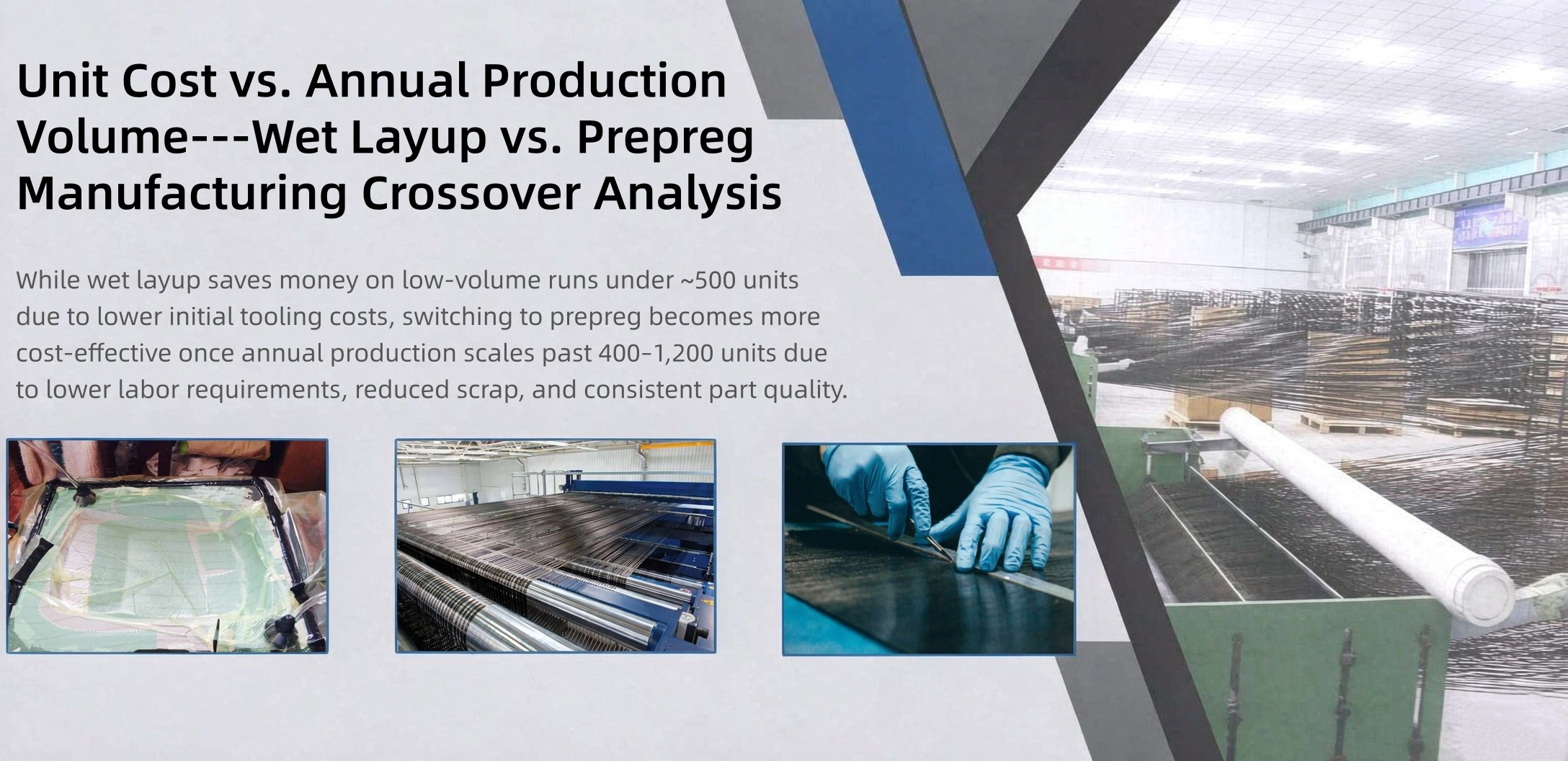
In practice, across the part sizes we build most often – roughly A5 to A3 footprint, 2 to 8 plies – the crossover tends to land somewhere between 400 and 1,200 units per year, moving higher for larger or more complex geometries and lower for small, simple parts. I’d treat any number tighter than that as marketing, not engineering. Your shop rate, your part geometry, and your cure cycle length all shift it.
4.A Case From Our Floor
A few years ago we worked with a European paddle sports brand that had been prototyping a carbon fiber blade insert through wet layup with a local fabricator. It worked fine for their first 200-unit run. When their distributor pushed for a 2026 season order in the low thousands, the wet layup shop quoted a per-part price that barely moved from the prototype run, because labor didn’t scale down – and their quality team was seeing inconsistent flex from part to part, which is a real problem in a paddle blade.
We requalified the part in prepreg with a matched-tool press cure. Cycle time dropped, fiber volume fraction tightened up, and – this is the part that mattered most to them – blade stiffness variation across a batch dropped enough that their QA team stopped hand-sorting parts by feel before shipping. I want to be careful here and say the exact percentage improvement varies by part and by how loose the original wet layup process was running; I’m not going to hand you a number that implies every switch performs identically. What I can tell you is that the pattern – tighter consistency, lower per-part cost once volume clears four figures – is one we see repeatedly, not a one-off.
5.Carbon Fiber Industry Parameters and Technical Standards Reference
One thing I always tell engineers who are new to sourcing composites: don’t just take a supplier’s word for “high fiber volume fraction” or “low void content.” Ask which test method the number was generated against. The table below is the reference sheet I actually hand to clients when they’re writing a qualification spec for either process – it’s the same set of standards our own quality team checks incoming prepreg and outgoing laminates against.
| Parameter | What It Verifies | ISO Standard | ASTM Standard | Typical / Notes |
| Fiber grade / tow classification | Filament count, tensile grade of the raw fiber | ISO 10618 | ASTM D4018 | e.g., 3K, 12K, 24K tow; T300/T700-class |
| Fiber volume fraction (Vf) | Fiber content vs. resin content by volume | ISO 14127 | ASTM D3171 | Wet layup ~45-55%; prepreg ~55-65% |
| Void content | Trapped air/porosity in the cured laminate | ISO 15901 (related, not a direct 1:1) | ASTM D2734 | Aerospace-grade prepreg often <1% |
| Resin content | Resin mass fraction relative to fiber | ISO 1172 | ASTM D3529 | Controlled tightly in prepreg; variable in wet layup |
| Cure characterization (DSC) | Degree of cure, exotherm, cure kinetics | ISO 11357-1 | ASTM E2160 | No exact ISO/ASTM crosswalk – compare within one standard only |
| Glass transition temperature (Tg) | Upper-use temperature of the cured resin | ISO 11357-2 | ASTM D3418 | Confirms cure is complete and part won’t soften in service |
| Laminate tensile strength/modulus | In-plane mechanical performance | ISO 527-4 | ASTM D3039 | Used to validate design allowables |
| Interlaminar shear strength | Bond quality between plies | ISO 14130 | ASTM D2344 | Sensitive indicator of poor wet-out or voids |
| Prepreg tack & out-life | Workability and shelf-life tracking | No governing standard | No governing standard | Set by the resin manufacturer’s datasheet – request it in writing |
Table 2. Reference standards for the parameters that separate a well-controlled process from a loosely-run one, in either wet layup or prepreg. ISO and ASTM methods are broadly aligned but rarely word-for-word identical – if you’re comparing two suppliers, ask which standard each number was tested to before comparing them directly.
A quick note on that void content row, since I get asked about it often: there isn’t a single ISO standard that maps one-to-one onto ASTM D2734. Some labs reference ISO 15901’s approach for porosity in a broader materials sense, but for composite laminates specifically, most of the mills and test houses we work with still run D2734 or a matrix-digestion / image-analysis method and simply state their methodology in the report. If a supplier hands you a void content number with no method attached, ask – it’s a two-line email, and it tells you a lot about how seriously they take their own QA.
6.A Practical Decision Checklist
Before you commit either direction, walk through these questions with your own numbers, not industry averages:
- What’s your realistic annual volume 18 months from now, not just this year’s PO?
- Does the part have a mechanical property spec – stiffness, fatigue life, fiber volume fraction – that wet layup’s variability puts at risk?
- Do you have, or can you get access to, an oven or press with the right platen size and temperature uniformity for prepreg cure?
- What does your shop actually charge per hour for skilled composite layup labor? This number alone often decides the crossover point.
- Is your part geometry simple enough that hand layup quality is easy to hold, or complex enough that operator skill becomes the biggest variable?
7.Mistakes I See Engineers Make Here
- Comparing raw material price per kilogram and stopping there, without pricing in labor and scrap.
- Switching to prepreg before volume justifies it, then getting stuck amortizing an oven cycle across too few parts.
- Staying on wet layup past the point where quality variability starts generating customer complaints, because “it’s always worked before.”
- Not asking the manufacturer for actual fiber volume fraction and void content data – both processes can be done well or badly, and the numbers tell you which you’re getting.
If you take nothing else from this section: ask for test data against a named standard before you compare two quotes. “High quality” isn’t a specification. A void content number tested to ASTM D2734 is.
8.Frequently Asked Questions
8.1Can I mix wet layup and prepreg on the same part?
Yes – this is more common than people expect. A prepreg skin over a wet-layup or foam core, for example, is a standard approach when you need surface quality and stiffness on the outside but want to control cost and weight in the core. We do this regularly on larger structural panels.
8.2Does prepreg always require an autoclave?
No. Many prepreg systems are designed for oven cure at low pressure (vacuum bag only) or press cure, not autoclave. Autoclave is reserved for the highest-performance aerospace-grade parts where void content has to be pushed below about 1%. For most industrial, sporting goods, and automotive parts, oven or press cure prepreg is more than sufficient and considerably cheaper to run.
8.3How much shelf life does prepreg actually have?
Typical epoxy prepreg systems run 6-12 months frozen at around -18°C, with a much shorter out-time once warmed to room temperature for layup – often just 10-30 days total, tracked cumulatively. This is a real logistics factor for smaller manufacturers and part of why minimum order quantities matter when sourcing prepreg.
8.4Is there a middle option if I can’t commit to either?
Compression molding with chopped or semi-preg material can sit between the two, offering better consistency than wet layup without the full cold-chain and cure-equipment commitment of continuous prepreg. It’s worth a conversation if your volume is right on the crossover line.
9.Where This Leaves You
If there’s one thing I’d want an engineer to take away from this, it’s that the process decision isn’t really about which material is “better.” It’s about matching the process to your actual volume, your actual quality requirements, and your actual shop economics. I’ve seen companies overspend on prepreg tooling for a part that will never clear 300 units a year, and I’ve seen others stay on wet layup two years past the point where it was costing them more in scrap and customer complaints than a press cure would have cost in equipment.
If you’re at that decision point right now, send us your part drawing and your projected annual volume. We run both processes in-house, and we can usually tell you within a day which one actually pencils out for your numbers – not just which one sounds more advanced.
About the Author
Qi Bing is CEO and Technical Director of Dezhou Hongjin Composite Materials Co., Ltd. (Carbon OEM), a Chinese carbon fiber manufacturer with over ten years of experience and a technical team of more than ten engineers, serving B2B clients across sports equipment, medical, marine, automotive, industrial machinery, and motorcycle sectors.


Leave a Reply
Want to join the discussion?Feel free to contribute!