
Unidirectional (UD) Fabric vs. Woven Fabric in Load-Bearing OEM Components: What Ten Years on the Layup Table Taught Me
By Qi Bing, CEO & Technical Director, Dezhou Hongjin Composite Materials Co., Ltd.
| QUICK ANSWER
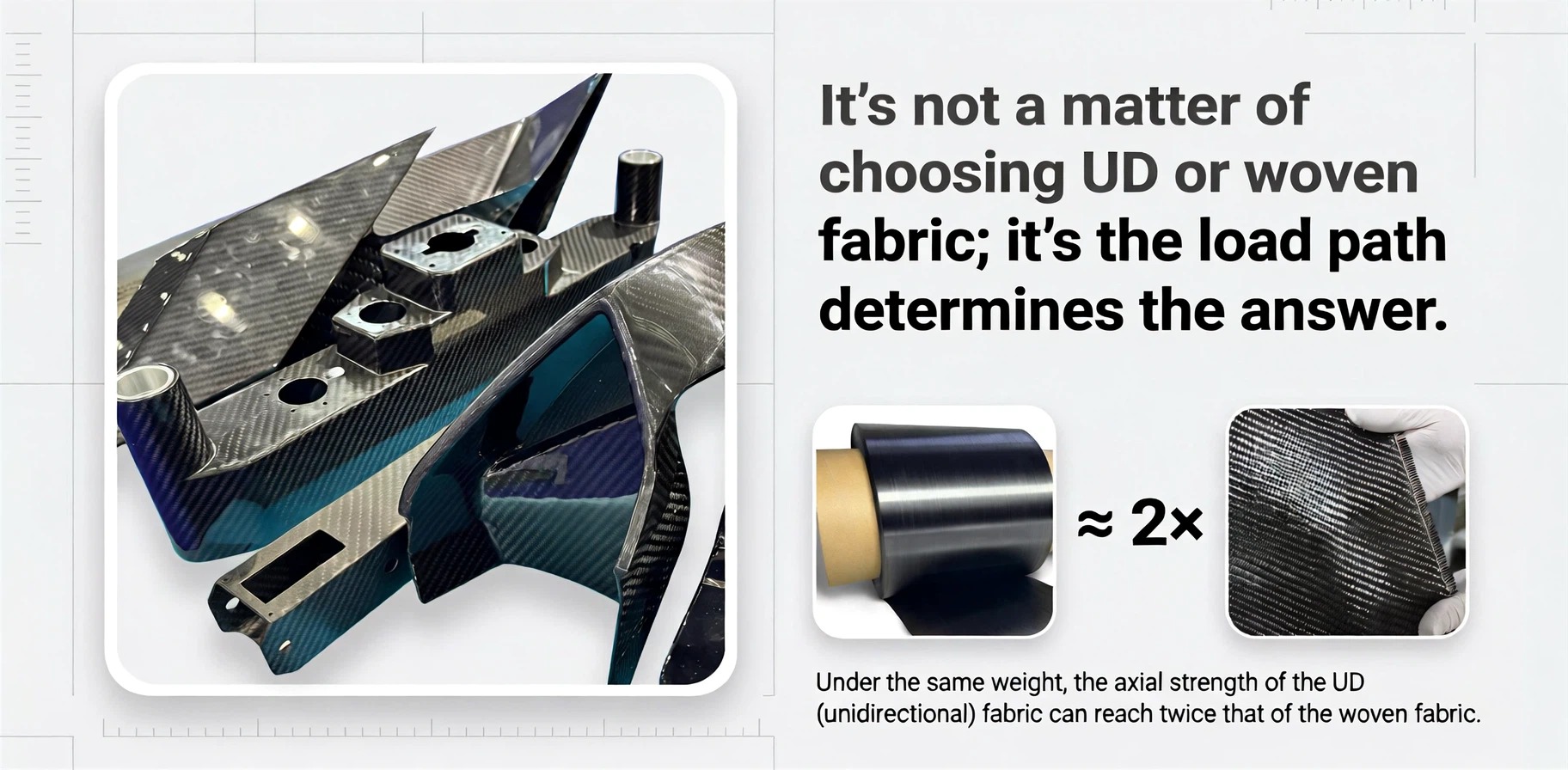
• UD fabric wins when the load path is known and mostly one-directional — it delivers roughly 2x the stiffness and strength of woven fabric along the fiber axis, because there’s no crimp to straighten out before the fiber can carry load. • Woven fabric wins when a part sees multi-directional or unpredictable loading, needs to drape over complex curves, or has to survive rough handling on the layup table without fraying at the edges. • Most serious load-bearing OEM parts I’ve built are not “UD or woven” — they’re UD-dominant laminates with a thin woven or braided outer skin for torsional stability and impact tolerance. • The wrong choice almost never shows up on a spec sheet. It shows up as a warranty claim eighteen months later, at a load angle nobody bothered to model. |
I get some version of this argument in almost every client call, and I mean that literally — not once a month, closer to once a week. A procurement manager sends over a drawing, the drawing calls out “3K carbon fiber, 200gsm,” and that’s it. No fiber orientation. No ply schedule. No mention of whether the part needs to survive a bending load, a torsional load, or an impact. I ask which fabric architecture they actually need — unidirectional or woven — and about half the time the honest answer is: “whichever one you recommend.”
That question is where good parts and bad parts start to diverge, and after ten years of running a composites factory in Dezhou, I’ve stopped being polite about it. So let me walk through this properly, the way I’d walk a new engineer through it on our own shop floor, because the difference between UD and woven fabric isn’t a matter of taste or brand preference. It’s physics. Get it backwards on a load-bearing bracket, a prosthetic strut, or a marine tiller arm, and you end up with a part that looks perfect on the bench and fails in the field, usually at the worst possible moment.
I’ll also say upfront: I have opinions in this article that not every supplier will agree with. Good. If everyone in this industry agreed on everything, there’d be nothing worth writing.
1. The Physical Difference: Crimp Is the Whole Story
Unidirectional fabric has every fiber running in one direction, held together by a light cross-stitch or a resin binder rather than being woven at all. Because the fibers stay straight, there’s essentially zero crimp — no up-and-down waviness along the length of the tow. Woven fabric, whether plain, twill, or satin, interlaces tows over and under each other, and every single crossover point introduces a small bend in the fiber.
That bend matters more than most buyers expect, and it took me a few years of testing to really internalize how much it matters. A carbon fiber tow loaded in pure tension along its own axis is extraordinarily strong — carbon fiber itself is one of the stiffest engineering materials available per unit weight. But the same tow, forced to bend even a few degrees at each weave crossover, starts to fail at a noticeably lower stress, because the load first has to straighten the fiber out before it can be carried efficiently. In our own tensile testing on 3K and 12K tows across several resin systems, we consistently see woven laminates land somewhere around 55-70% of the tensile strength and stiffness of a 0° UD laminate at an equivalent fiber volume fraction. The exact number moves around depending on resin system and weave tightness, but the direction of the effect never changes, not once in ten years of testing.
This single fact should drive most of the material decisions in this article. Everything else — drape, cost, handling, aesthetics — is a secondary consideration layered on top of it, and in my experience it’s the secondary considerations that get all the attention in sales conversations while the primary one gets ignored.
2. Typical Material Parameters: UD vs. Woven, by Fiber Grade
Buyers often ask us for hard numbers rather than general statements like “UD is stronger.” Fair enough. Below is a representative parameter table drawn from our own lab testing and common industry data for three of the most widely used carbon fiber grades in OEM manufacturing — Toray-equivalent T300, T700, and T800 grades. These are typical ranges, not guaranteed values for any specific batch; actual performance depends on resin system, cure schedule, void content, and fiber volume fraction, so always request a batch-specific test report for a part that matters.
| Fiber Grade / Architecture | 0° Tensile Strength (MPa) | 0° Tensile Modulus (GPa) | Density (g/cm³) | Typical Resin Content (%) |
| T300 — UD | 1,500 – 1,600 | 130 – 135 | 1.55 – 1.60 | 38 – 42 |
| T300 — Woven (Plain/Twill) | 550 – 650 | 60 – 70 | 1.55 – 1.60 | 42 – 48 |
| T700 — UD | 2,000 – 2,100 | 130 – 140 | 1.55 – 1.60 | 38 – 42 |
| T700 — Woven (Plain/Twill) | 700 – 800 | 65 – 75 | 1.55 – 1.60 | 42 – 48 |
| T800 — UD | 2,300 – 2,500 | 155 – 165 | 1.55 – 1.60 | 36 – 40 |
| T800 — Woven (Plain/Twill) | 850 – 950 | 75 – 85 | 1.55 – 1.60 | 40 – 46 |
A couple of things jump out when I look at this table with a client on a call. First, the strength gap between UD and woven doesn’t shrink as fiber grade goes up — it actually widens in absolute terms, because higher-modulus fibers are less tolerant of the bending strain imposed by weaving. Second, woven fabric consistently carries a higher resin content, typically four to six percentage points more, because the crimped architecture leaves more resin-rich pockets at each crossover. That extra resin adds weight without adding fiber-direction strength, which is part of why an all-woven part on a weight-sensitive application — a bike frame, a drone arm, a prosthetic socket — often ends up heavier than it needs to be for the stiffness it delivers.
3. Side-by-Side Comparison for OEM Load-Bearing Parts
| Property | UD Fabric | Woven Fabric (Twill/Plain) |
| Fiber crimp | None — straight fibers | Present at every crossover |
| Tensile/flexural strength (fiber axis) | Highest achievable per given fiber weight | Roughly 55-70% of UD at same fiber volume |
| Multi-directional (in-plane) strength | Weak off-axis without added plies | Balanced in warp/weft directions |
| Drapability over complex curves | Poor to moderate — prone to wrinkling | Good — designed to conform |
| Handling & cut-edge fray resistance | Fragile before cure; needs careful ply handling | More forgiving; interlacing holds tows in place |
| Torsional stiffness | Poor unless plies are angled (±45°) | Naturally better in-plane torsional behavior |
| Impact damage tolerance | Can split along fiber direction on impact | Interlacing helps arrest crack propagation |
| Surface cosmetics | Not typically used as a visible surface ply | Preferred for visible weave-pattern finish |
| Typical cost per kg (comparable grade) | Slightly lower raw material cost | 5-15% premium due to weaving process |
| Best process fit | Filament winding, pultrusion, tailored layup | Hand layup, vacuum bag, compression molding |
4. Where I Push Back on the “Woven Is Safer” Assumption
Here’s where I’ll say something that puts me at odds with a fair amount of the marketing copy floating around this industry. Plenty of suppliers push woven fabric as the safe, default, all-purpose choice for structural parts, because it’s easier to explain to a nervous buyer and easier to manufacture with less scrap. I understand the commercial logic — I run a factory too, and I know what it costs to train a layup technician on UD ply placement versus handing them a roll of pre-woven cloth. But understanding the logic doesn’t mean I think it’s good engineering, and I’ll say plainly: it usually isn’t.
If a component genuinely has a dominant load direction — a bicycle chainstay taking bending loads under pedaling, a prosthetic pylon under axial compression, a UAV wing spar in bending — putting an all-woven layup in that part leaves strength and weight savings on the table that the customer already paid for and never actually received. I’ve re-engineered more than one client’s “failed” bracket over the years, and the root cause was never a resin problem or a cure problem, no matter how much the original supplier wanted to blame the resin batch. It was a 100% woven layup on a part that needed UD fiber running along the load axis, with woven or braided plies added only where torsion or impact genuinely demanded it.
The opposite mistake is just as common, especially with newer OEM buyers who’ve read exactly one article about UD fiber being “twice as strong” and now want to specify all-UD construction on everything, including brackets that see loading from multiple directions in actual service. An all-UD part with no off-axis reinforcement can split like firewood the first time it takes a side load nobody planned for. I’ve seen this exact failure mode on a customer’s own in-house prototype, built without our input, and it wasn’t subtle — it split clean along the fiber line on the second drop test. Both extremes come from treating this as a marketing decision instead of a load-path decision, and both extremes cost the client money eventually.
5. A Framework I Actually Use With Clients
Before quoting fabric architecture on any new load-bearing OEM inquiry, our technical team asks three questions, every time, no exceptions:
- What is the dominant load direction, and how confident is the engineering team in that assumption? Bending, axial, torsional, or some combination?
- Does the part need to survive an unplanned side-impact or handling load in service, separate from its designed duty cycle?
- What is the part geometry — flat, straight-tube, or compound-curved — and does that geometry make clean UD placement difficult without wrinkling?
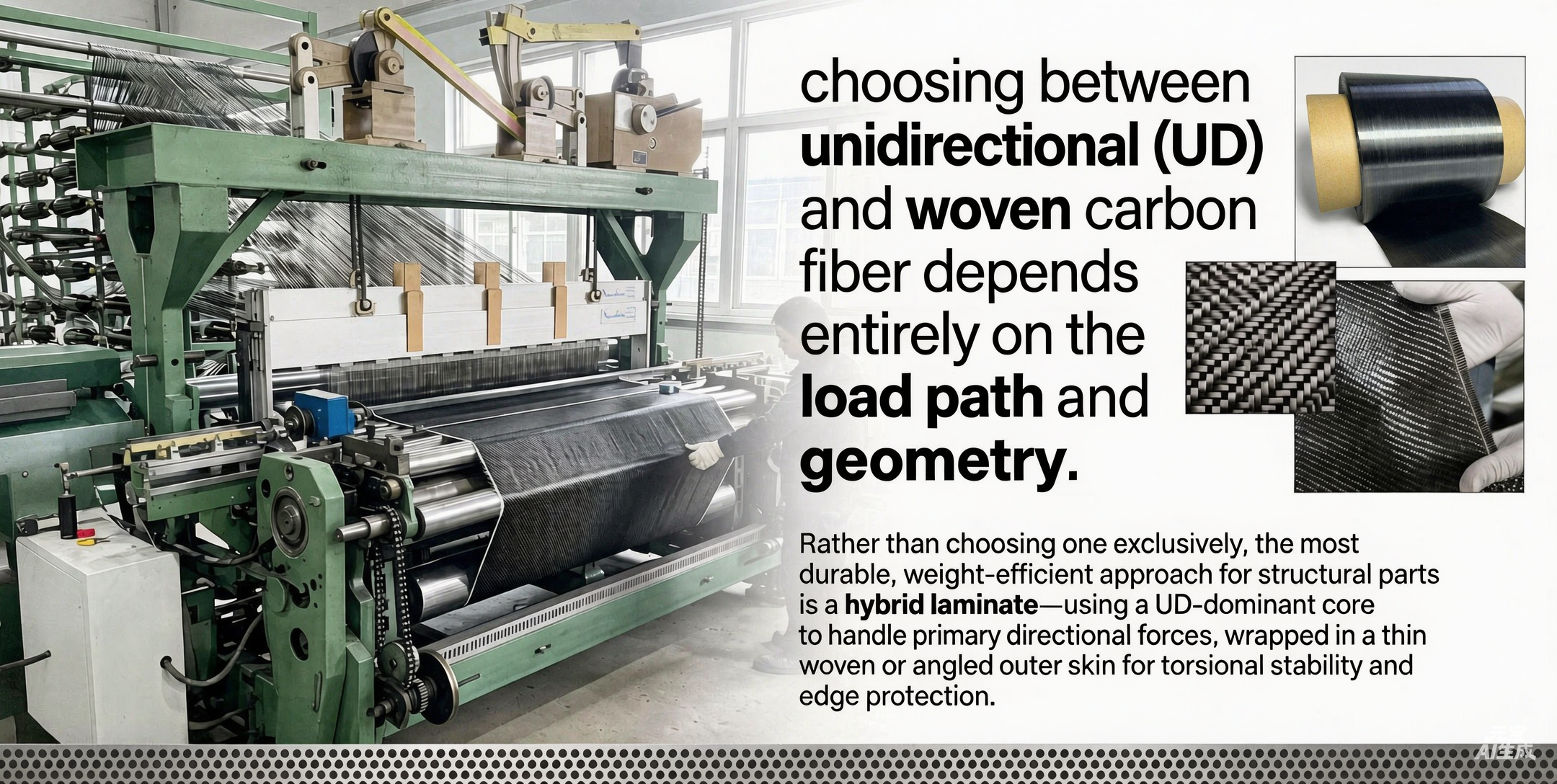
A part with a clear, dominant load direction and simple geometry — a straight tube, a flat strut, a linear connecting rod — is the textbook UD case: 0° UD plies carrying the primary load, with a modest ±45° or woven outer wrap for torsion and surface integrity. A part with a compound curve, an unpredictable load case, or a cosmetic surface requirement leans woven, sometimes with UD reinforcement added only at the highest-stress local zones rather than throughout the laminate. It’s rarely all-or-nothing once you actually sit down with the load case.
6. Case Study: Re-Engineering a Marine Tiller Arm Bracket
Here’s an example that comes up a lot in our marine hardware inquiries, and it stuck with me because it’s such a clean illustration of the crimp problem. A small-boat tiller arm bracket had originally been specified as all-woven 3K twill, four plies, quasi-isotropic layup. On paper it looked correct, and it passed static bench testing without any issue. In the field, though, several units developed hairline cracking at the pivot boss after repeated cyclic loading from wave action and steering torque — a fatigue failure, not a one-time overload, which is a different animal to diagnose.
The dominant load at the pivot boss was bending, concentrated along a single, fairly predictable axis defined by the tiller’s swing arc. We restructured the layup to place two 0° UD plies along that primary bending axis, sandwiched between two thin ±45° woven plies for torsional stability and surface durability at the boss. Fiber volume and part thickness stayed essentially the same, so cost and weight barely moved. What changed was directional stiffness exactly where the fatigue cracking had originated. In accelerated cyclic bench testing afterward, the redesigned bracket ran well beyond the cycle count at which the original woven-only part had shown crack initiation.
I’ll be honest about the limits of this example — every part behaves a little differently depending on geometry, resin system, and load spectrum, so I’m not going to pretend this exact ply schedule is a universal fix. But the underlying lesson generalizes well: fatigue and directional stiffness problems are almost always laminate architecture problems before they’re resin or cure problems. This is the kind of layup review our technical team runs on every new OEM drawing before quoting, precisely so we catch this class of issue before tooling is cut, not after a customer reports field failures.
7. A Second Case: Sporting Goods and the Drape Problem
Sports equipment gives a good counter-example, because it’s where woven fabric earns its keep in ways that are easy to underestimate if you only think in terms of raw tensile numbers. We’ve worked on hockey stick shafts, paddle cores, and racket components where the geometry curves and tapers continuously along the part’s length. Try to lay pure 0° UD fiber down a tapering, curving shaft and you’ll fight wrinkling at every station change — the fiber simply doesn’t want to follow a compound curve without buckling somewhere.
On these parts, we typically use a woven or braided sleeve as the base structural layer specifically because it drapes cleanly over the taper, then add localized UD reinforcement only at the sections carrying the highest bending load — the lower third of a hockey stick shaft, for instance, where the player loads the shaft against the ice. The result isn’t as theoretically “efficient” as a full UD layup would be if the geometry allowed it, but the geometry doesn’t allow it, and pretending otherwise just gets you a wrinkled, resin-rich part with hidden voids at every fold. Sometimes the honest engineering answer is that woven fabric wins not because it’s stronger, but because it’s the only thing that will physically conform to the part.
8. A Table of Buyer Mistakes We See Repeatedly
| Common Buyer Assumption | Why It Backfires | What We Recommend Instead |
| “Woven is stronger because it’s balanced in both directions.” | Balanced does not mean strongest — off-axis reinforcement dilutes peak strength on the primary load axis. | Identify the dominant load axis first; balance only where multi-directional loading is confirmed. |
| “UD fiber is always the premium, better choice.” | All-UD laminates can be brittle to unplanned side loads and are hard to drape on curved geometry. | Combine UD core plies with a woven or ±45° outer wrap for torsion and impact tolerance. |
| “We’ll just spec the same layup as our last supplier used.” | Prior layups were often built around a different geometry or a different failure mode than the new part. | Re-run the load-path analysis for each new part; don’t carry over an old ply schedule by default. |
| “Higher fiber weight (gsm) always means a stronger part.” | Fabric architecture affects strength per unit weight far more than gsm alone. | Optimize ply architecture and orientation before increasing total fiber weight. |
| “A thicker part is automatically a stiffer part.” | Stiffness depends on fiber orientation relative to load, not just laminate thickness. | Model deflection under the actual load case before adding plies purely for thickness. |
9. Production Parameters Worth Knowing Before You Quote
Since most readers of this article are sourcing managers or engineers evaluating OEM partners, not just students of composite theory, it’s worth laying out a few production-side numbers we get asked about constantly. These vary somewhat by part complexity, but this table reflects what’s typical for custom load-bearing components at our facility.
| Parameter | UD-Dominant Layup | Woven-Dominant Layup |
| Typical prototype lead time | 10 – 15 working days | 7 – 12 working days |
| Typical mass production MOQ | 50 – 200 pcs, part-size dependent | 50 – 200 pcs, part-size dependent |
| Layup labor time (relative) | Higher — precise ply placement and angle control | Lower — fabric conforms more readily |
| Scrap rate on complex curves | Higher without darting/segmenting | Lower — better natural drape |
| Recommended QC checkpoints | Fiber angle verification, void content, ply count | Weave alignment, resin content, ply count |
None of these numbers should be treated as a quote — every part is different, and geometry complexity moves lead time more than fabric choice does on its own. But I’d rather give buyers a realistic planning range upfront than have them find out three weeks into a project that the timeline they assumed was never realistic to begin with.
10. Practical Tips for OEM Buyers Specifying a New Part
- Send us the actual load case, not just a fabric name. A drawing that says “carbon fiber, 3K” tells us nothing about the direction of loading — the single most important variable in this whole decision.
- If your part has a known duty cycle (cyclic bending, repeated torsion, occasional impact), say so explicitly. Static strength and fatigue life are driven by different aspects of laminate architecture, and a supplier who doesn’t ask about duty cycle probably isn’t designing for it.
- Ask your supplier to show you the ply schedule, not just the fabric type. “70% carbon fiber” is not a ply schedule. “4 plies: 0°/±45°/±45°/0°” is, and any competent technical team should be able to hand you one.
- For compound-curved geometry, ask whether UD placement is even feasible without wrinkling before specifying it — sometimes a hybrid tow-spread fabric or a localized UD patch is the realistic answer, not full UD coverage.
- Request comparative test data (tensile, flexural, in-plane shear) referencing recognized ASTM/ISO methods, especially for parts headed into regulated sectors like medical or marine equipment.
- Don’t assume your last supplier’s ply schedule transfers to a new part just because the fiber grade is the same — geometry and load case both need to be re-evaluated.
11. Reference Table: Standards Relevant to UD vs. Woven Performance Comparisons
When we run comparative testing between UD and woven laminates for a client, or when a client’s own QA team wants to verify our data, these are the standards we reference most often. I include both the ASTM and the nearest ISO counterpart, because international buyers frequently ask for one or the other, and the two aren’t always a perfect one-to-one match — a detail that trips up a surprising number of purchasing teams.
| Property Tested | ASTM Standard | Nearest ISO Standard | Note |
| Tensile strength/modulus | ASTM D3039 | ISO 527-4 | Similar methodology; specimen geometry differs slightly. |
| Flexural strength/modulus | ASTM D7264 | ISO 14125 | Both use three- or four-point bending; span-to-thickness ratios must match for comparable results. |
| In-plane shear (±45°) | ASTM D3518 | ISO 14129 | Directly relevant to comparing woven vs. angled UD off-axis behavior. |
| Fiber volume / void content | ASTM D3171 | ISO 1172 | Void content affects UD laminates more severely, since there’s no crimp to help redistribute local stress concentrations. |
| Impact damage resistance | ASTM D7136 | ISO 18352 | Treat as approximate equivalents, not a strict 1:1 match — test parameters differ. |
| Density | ASTM D792 | ISO 1183 | Similar principle, but not directly equivalent; confirm method (A/B/C) when comparing lab reports. |
12. Where This Leaves Us
Ten years in this industry has left me with a fairly firm opinion, and I don’t mind stating it plainly: the UD-versus-woven question is not a preference, it’s an engineering conclusion that follows from the load path. Most well-engineered load-bearing OEM parts we produce at Dezhou Hongjin are hybrids — UD plies doing the heavy lifting along the dominant load axis, woven or angled plies protecting against torsion, impact, and the loads nobody bothered to model. Suppliers who present this as a simple either/or choice are usually optimizing for ease of manufacturing, not for the part’s actual service life, and I’d rather lose a quote to a competitor than win one by telling a client what’s easy instead of what’s right.
Our technical team reviews the load case and geometry on every custom quote before we recommend a fabric architecture, precisely because getting this wrong is invisible on a data sheet and expensive in the field. If you’re specifying a new load-bearing component — sporting goods, medical device structural components, marine hardware, automotive brackets, or industrial equipment parts — send us the load case and geometry, and we’ll tell you honestly whether UD, woven, or a hybrid layup is the right call, along with a ply schedule and cost comparison sized to your production volume.
13.Frequently Asked Questions
13.1 Is UD fabric always stronger than woven fabric?
Only along the fiber direction. Off-axis, an all-UD laminate can be considerably weaker than a woven laminate of the same weight, because it has little to no reinforcement perpendicular to the fiber axis unless additional angled plies are added.
13.2 Can I mix UD and woven fabric in the same part?
Yes, and for most structural OEM parts, I’d say you should. A common approach is UD plies along the primary load axis with a thin woven or ±45° outer layer for torsional stability, impact tolerance, and cosmetic finish.
13.3 Does UD fabric cost more than woven fabric?
Usually the opposite. UD fabric typically has a slightly lower raw material cost than woven fabric of comparable fiber grade, because the weaving process itself adds labor and equipment cost. The bigger cost driver on most quotes is actually ply count and layup labor, not the fabric type alone.
13.4 Which fabric type is better for parts with complex, curved geometry?
Woven fabric generally drapes more predictably over compound curves. UD fabric can still be used on curved parts, but it typically requires more careful ply placement, sometimes segmented or dart-cut, to avoid wrinkling and fiber misalignment during layup.
13.5 What resin content should I expect on a UD versus a woven laminate?
In our own production data, UD laminates typically run 38-42% resin content by weight, while woven laminates run closer to 42-48%, because the crimped architecture leaves more resin-rich pockets at each crossover point. Higher resin content generally means added weight without a corresponding gain in fiber-direction strength.
13.6 How do I know if my part needs UD, woven, or both?
Start with the load path: identify the dominant loading direction, whether the part experiences torsion or off-axis loads, and whether unplanned impact is a realistic service condition. Send that information, along with part geometry, to your fabrication partner’s technical team for a ply schedule recommendation, rather than specifying a fabric type in isolation.
13.7 Does fiber grade (T300 vs. T700 vs. T800) change this decision?
Not fundamentally — the crimp penalty on woven fabric applies across fiber grades. Higher-modulus fibers like T800 actually show a wider absolute gap between UD and woven performance, since stiffer fibers tolerate bending strain less gracefully.
| ABOUT THE AUTHOR
• Qi Bing is CEO and Technical Director of Dezhou Hongjin Composite Materials Co., Ltd. (carbonoem.com), a China-based custom carbon fiber OEM manufacturer with roughly ten years of production experience across sports equipment, medical devices, marine hardware, automotive components, industrial equipment, and aerospace parts. • The company operates with a dedicated technical team of over ten engineers and supports overseas OEM and ODM clients with custom mold design, layup engineering, and production at volumes ranging from prototype runs to full-scale manufacturing. • For a load-path review, ply schedule recommendation, or production quote on a load-bearing carbon fiber component, contact the Dezhou Hongjin technical team through carbonoem.com. |


Leave a Reply
Want to join the discussion?Feel free to contribute!