
Applications of Carbon Fiber Plates: A Versatile Material from Aerospace to Daily Life
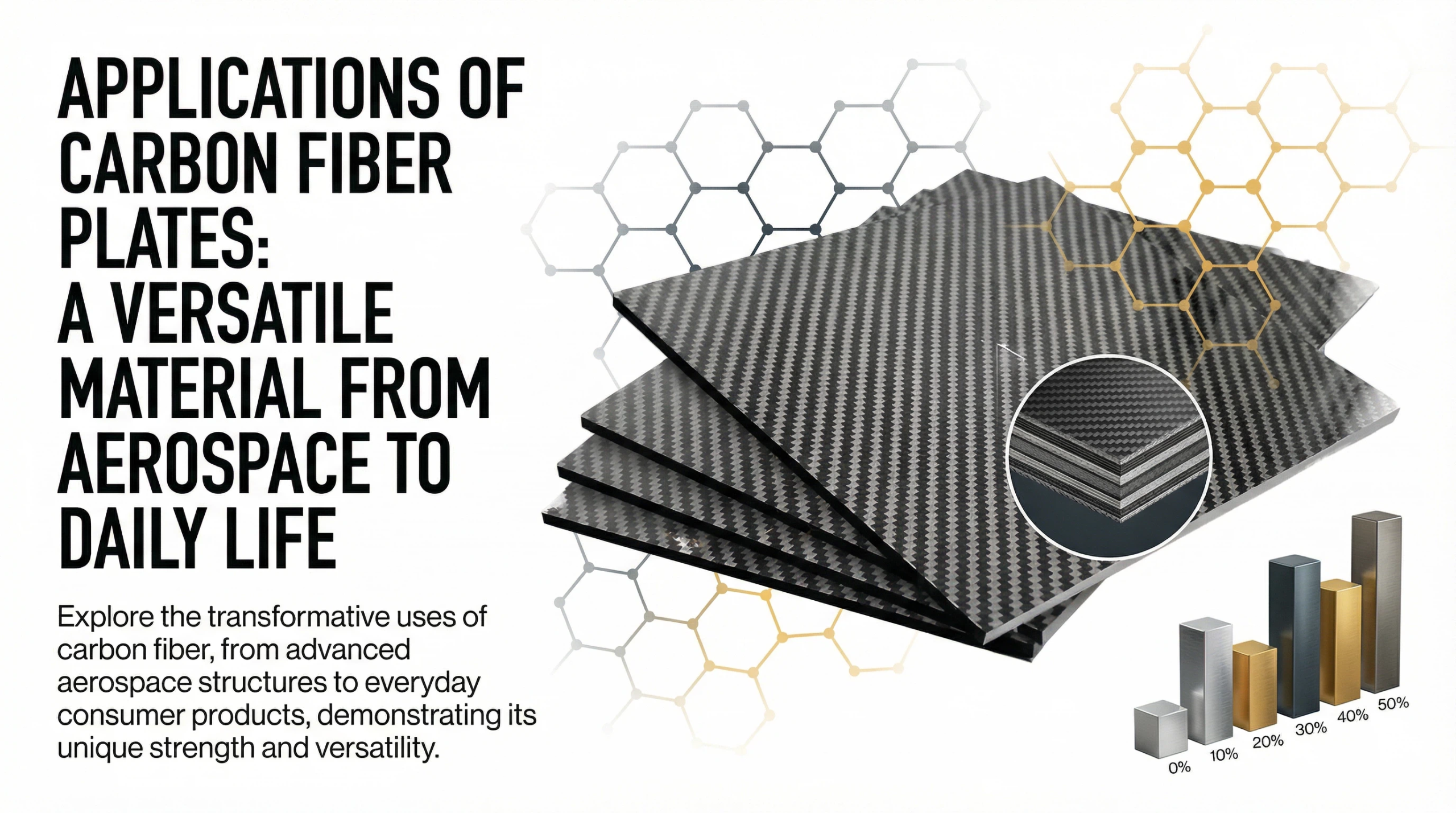
Hello everyone, I am Qi Bing, responsible person at Hongjin Carbon Fiber Composite Materials, with ten years of in-depth experience in the carbon fiber field.
In modern materials science, carbon fiber plates are quietly transforming the development trajectory of numerous industries due to their exceptional performance and broad application prospects.
This black, lightweight material not only carries the pursuit of extreme performance but also gradually integrates into our daily lives, becoming a of perfect integration of technological innovation and practicality.
1. Basic Characteristics and Advantages of Carbon Fiber Plates
Carbon fiber plates are high-performance materials composed of carbon fiber filaments and a resin matrix.
Their main characteristics include light weight, high strength, and reliable structural support capabilities.
The density of carbon fiber plates is approximately 1.6 g/cm³, only one-fourth that of steel, but their tensile strength can reach 6–9 times that of steel, up to over 3500 MPa, making them an ideal choice for lightweight design .
The excellent performance of carbon fiber plates stems from strict raw material control and manufacturing processes.
Currently, polyacrylonitrile-based carbon fibers (accounting for over 90%) are predominantly used.
Their production process includes three key stages: pre-oxidation of the precursor (200–300°C), carbonization (1000–1500°C), and graphitization (2500–3000°C).
The diameter of high-performance carbon fibers is controlled within the range of 5–7 micrometers, with single-filament strength requiring above 4.0 GPa and modulus not less than 230 GPa .
In terms of resin matrix selection, epoxy resins dominate (about 70%).
Their formulation must precisely balance viscosity (0.3–0.5 Pa·s), gel time (60–90 minutes), and glass transition temperature after curing (Tg ≥ 120°C). Prepreg preparation is a key step in ensuring the performance of the molded product.
Modern prepreg production lines use hot-melt film or solution impregnation methods to strictly control resin content at 35 ± 2% and volatiles below 0.8% .
Table: Performance Comparison of Carbon Fiber Plates, Steel, and Aluminum Alloy
| Performance Indicator | Carbon Fiber Plates | Steel | Aluminum Alloy |
| Density (g/cm³) | 1.6–2.0 | 7.85 | 2.7 |
| Tensile Strength (MPa) | 2400–4900 | 300–500 | 100–400 |
| Specific Strength (Strength/Density) | 1500–3060 | 38–64 | 37–148 |
| Corrosion Resistance | Excellent | Poor | Moderate |
| Thermal Expansion Coefficient (10⁻⁶/K) | 0.6–1.2 | 11–16 | 23–24 |
Carbon fiber plates can be classified into various types based on structural composition: 0°/90° balanced laminate carbon fiber plates exhibit excellent strength and stiffness both longitudinally and transversely; quasi-isotropic carbon fiber plates (0°/90°/45°) are suitable for multi-directional loading scenarios; prepreg carbon fiber plates are made from unidirectional carbon fiber prepreg and/or twill weave carbon fiber prepreg, manufactured in hot presses to provide higher fiber volume, reduced voids, and higher temperature performance .
The unique microstructure of carbon fiber plates gives them anisotropic characteristics—high stability and high modulus along the fiber axis, while strength is relatively lower perpendicular to the fiber direction.
This allows engineers to optimize the fiber layup direction according to load requirements, enabling targeted design of material performance .
2. Applications in Aerospace and Military Fields
Carbon fiber plates play an irreplaceable role in the aerospace sector, with about 30% of all carbon fiber production used in the aerospace industry.
In modern aircraft manufacturing, carbon fiber plates are widely used in wings, fuselage structures, interiors, and engine components.
Using carbon fiber plates can reduce aircraft weight by 20%–30%, while improving fuel efficiency and lowering operating costs .
Applications in the aerospace field are equally broad.
In satellite manufacturing, the use of carbon fiber in components such as antennas and solar panels reduces satellite weight and improves in-orbit efficiency.
Carbon fiber composites account for about 60% of modern satellite solar panels.
Some aerospace companies even use 3D printing technology to manufacture large composite rocket structures, with automated fiber placement machines offering extremely high efficiency.
Carbon fiber plates have achieved lightweight energy collection panels with orbital environment adaptability in space solar power stations, demonstrating their strategic value in high-tech fields .
The advantages of carbon fiber plates in aerospace extend beyond lightweight. Their good thermal stability allows them to maintain performance stability in extreme environments from -180°C to 150°C, which is crucial for temperature fluctuations in space.
Additionally, carbon fiber plates exhibit excellent fatigue resistance and corrosion resistance, significantly extending the service life of aerospace equipment and reducing maintenance needs .
Table: Key Applications and Advantages of Carbon Fiber Plates in Aerospace
| Application Part | Specific Uses | Performance Advantages | Practical Benefits |
| Wings & Fuselage | Primary structures, skins | High specific strength, high specific stiffness | 20%–30% weight reduction, improved fuel efficiency |
| Interior Components | Seats, luggage racks | Lightweight, flame retardant | Weight reduction, improved safety |
| Engine Components | Blades, covers | High temperature resistance, low thermal expansion | Improved engine efficiency, reduced maintenance |
| Satellite Structures | Solar panels, antennas | Lightweight, dimensional stability | Reduced launch costs, extended service life |
| UAVs | Wings, fuselage frames | Lightweight, high rigidity | Extended endurance, enhanced payload capacity |
The aerospace industry has extremely strict requirements for carbon fiber plates. Prepreg must be stored at ≤10°C, transported at -18°C frozen state, and warmed for 4 hours at 16–18°C before use. Such strict quality control ensures optimal performance of carbon fiber plates in aerospace applications, meeting the requirements for use in extreme environments .
3. Innovative Applications in Automotive Industry and Rail Transportation
In the automotive industry, carbon fiber plates have become a key material for achieving lightweight.
Used in body panels and interior components, they can significantly reduce overall vehicle weight, contributing to improved energy efficiency and enhanced handling. For example, seat frames made with carbon fiber plate molding weigh significantly less than traditional metal frames, aiding in reducing overall vehicle weight and thus improving fuel economy .
The application of carbon fiber plates in new energy vehicles is particularly prominent.
Battery pack casings use 3mm thick carbon fiber plates with mortise and tenon connections, achieving compressive strength ≥120 MPa. The insulation layer creates a 150°C temperature difference between inside and outside, effectively blocking thermal runaway risks.
As one of the heaviest components of electric vehicles, lightweight battery pack casings are significant for overall weight reduction.
Carbon fiber battery casings are not only light but also offer excellent thermal insulation and protective properties, ensuring battery safety .
In terms of manufacturing, carbon fiber body panels use hot press molding, with mold temperature controlled at 130±5°C and holding time of 3 minutes.
The finished hood weighs only 4.5 kg, 55% lighter than steel, with dent resistance of 80 N/mm and 30% improved energy absorption in crash tests.
Interior center console frames can weigh as little as 1.2 kg, with modal analysis showing a first-order natural frequency of 85 Hz, far exceeding in-vehicle vibration excitation frequencies, reducing resonance noise and improving comfort .
In rail transportation, carbon fiber plates also show significant advantages. Used in interior components like floors, side walls, and seats, they reduce vehicle weight, improve operational efficiency, and enhance passenger comfort .
Applications extend beyond interiors. Floor systems using carbon fiber plates significantly reduce weight while providing excellent wear resistance and comfort.
Additionally, carbon fiber plates are used for cable trays, optimizing wiring space and enhancing fire insulation.
These applications demonstrate the versatility and practical value of carbon fiber plates in rail transportation .
Carbon fiber plates are also used in special vehicles. For example, in high-speed racing cars, they are used for key body parts to enhance crash protection and optimize aerodynamics.
In material handling, they are used for industrial cart frames, meeting heavy-duty needs. A 500 kg capacity cart with a carbon fiber frame weighs only 25 kg, 60% lighter than steel, and shows no deformation after 10 km of bumpy road testing .
4. Applications in Medical Equipment and Sports Gear
Carbon fiber plates show unique value in the medical field, especially in imaging equipment.
X-ray examination table boards use a sandwich structure (0.6 mm skin, 15 mm foam core), with X-ray absorption rates one-fifth that of aluminum and one-third that of wood, reducing radiation dose by about 30% and improving image clarity.
CT scanner carbon fiber supports meet non-magnetic and high radiation transparency requirements, avoiding metal artifact interference. Advanced technology integrates copper mesh shielding (80-100 mesh) to suppress electromagnetic interference .
In rehabilitation, carbon fiber plates are equally remarkable. Orthotic braces using carbon fiber plates reduce weight by 50%, improving patient compliance by 40%.
Prosthetic sockets using customized carbon fiber plates reduce weight by 45% and improve energy return by 30%, enhancing user gait.
Intelligent prostheses use a customized process with 3D scanning, reverse modeling, and carbon fiber sockets with memory foam, improving breathability by 60% and ensuring even pressure distribution .
Surgical robot structures made from carbon fiber plates meet sterilization requirements (resistant to hydrogen peroxide plasma) while reducing moving part inertia by 35%, improving precision.
Rehabilitation bed guardrails made from carbon fiber are light (1.2 kg each), easy to adjust, and strong enough to withstand 100 kg horizontal force without deformation .
In sports equipment, carbon fiber plates are widely used in bicycle frames, racket bodies, skis, and water sports gear.
For tennis rackets, production uses carbon fiber prepreg winding to ensure consistent performance.
The resulting racket offers excellent elasticity and strength, providing good feedback for better control .
In skis, the high rigidity of carbon fiber plates ensures stability.
In golf clubs, carbon fiber composites improve performance and feel. Aerial drone frames using carbon fiber plates improve adaptability by 35%, with 3D woven structures weighing one-third of aluminum, extending battery life by 40% and withstanding 12-level winds .
Table: Main Applications of Carbon Fiber Plates in Medical and Sports Fields
| Application Field | Specific Products | Key Performance Advantages | Measured Effects |
| Medical Imaging | X-ray table boards, CT supports | X-ray transparency, non-magnetic | 30% less radiation, clearer images |
| Prosthetics & Rehab | Intelligent prostheses, orthotics | Lightweight, high specific strength, energy return | 45-50% weight reduction, 30% gait improvement |
| Surgical Robots | Structural components | Lightweight, sterilization adaptability | 35% reduction in moving part inertia |
| Sports Equipment | Tennis rackets, skis | High rigidity, vibration damping | Improved control, reduced fatigue |
| UAVs | Fuselage frames, wings | Lightweight, high rigidity, wind resistance | 40% longer battery life, withstands 12-level winds |
5. Wide Applications in Electronic Equipment and Construction
Carbon fiber plates are increasingly used in electronic equipment, providing lightweight, high-strength, and aesthetically pleasing solutions.
In tablet keyboard case manufacturing, they show excellent performance. Cases are designed with precise cutouts and smooth edges.
Using injection molding at 185°C and 85 MPa pressure for 35 seconds, the case forms .
The finished case weighs only 50 g, 30% lighter than plastic, with good wear resistance—no significant wear after 100,000 keystrokes.
Corner impact-absorbing structures with 3 mm EVA foam absorb shock, protecting the device in 1-meter drop tests .
In electronics heat dissipation, carbon fiber plates also show unique value, achieving heat conduction and lightweight structure integration.
Good thermal conductivity combined with light weight makes them ideal for efficient cooling solutions.
They are also used for tablet cases, device mid-frames, and tripod parts, providing dimensional stability and vibration damping .
In construction and civil engineering, carbon fiber plates are equally important. They are widely used for strengthening buildings, bridges, tunnels, chimneys, and towers.
The carbon fiber plate strengthening method offers easy construction and quality assurance, without wet work, large equipment, or fixed facilities.
Plates can be cut to length, simplifying construction and shortening deadlines .
Advantages include not only construction convenience but also excellent durability and corrosion resistance.
Resistant to acids, alkalis, salts, and atmospheric conditions, they require no regular maintenance and protect internal structures, achieving dual reinforcement. In railway construction, large roof systems and sound barriers are promising applications.
Roof trusses made with carbon fiber tubes are 50% lighter than steel, making large structures practical and improving seismic performance .
Applications extend beyond structural strengthening to include curtain walls, sunshades, etc., combining lightweight design with modern aesthetics. Additionally, carbon fiber plates are used for laboratory ventilation ducts, offering corrosion resistance and flame retardancy, providing safe and durable solutions .
6. Future Development Trends and Prospects
With the promotion of sustainable development, recycling technologies for carbon fiber plates are becoming important.
Current main recycling methods include high-temperature pyrolysis (decomposing resin in inert atmosphere to recover carbon fiber), chemical solvent method (selectively dissolving resin to preserve fiber structure), and physical crushing (preparing short fiber reinforcement).
Recycled materials, though with reduced mechanical properties, are still valuable for electronic product cases, automotive non-structural parts, and construction formwork.
In raw material production, reducing the energy consumption of the carbonization process (over 70% of total energy) is a key breakthrough direction, involving efficient heating technology and waste heat recovery systems .
Research on bio-based precursors (like lignin fiber) is advancing, potentially further reducing environmental impact.
Future directions include developing low-cost large-tow carbon fiber production processes, promoting thermoplastic matrix composites for better recyclability, exploring structure-function integrated plates (e.g., smart materials with integrated strain sensors), and reducing application thresholds for civilian products like new energy vehicle battery boxes through modular design.
These innovations will promote broader application while reducing environmental impact .
Applications in smart materials are broad. For example, carbon fiber plates can combine with sensor technology for structural health monitoring, providing early warnings in infrastructure.
This trend will shift carbon fiber plates from structural materials to multifunctional materials, meeting complex needs .
Table: Main Directions and Key Technologies for Future Development of Carbon Fiber Plates
| Development Direction | Key Technologies | Expected Benefits | Application Prospects |
| Sustainable Development | Recycling tech, bio-based precursors | Reduce environmental impact, enable recycling | Electronic product cases, automotive non-structural parts |
| Smart Materials | Structure-function integration, sensor integration | Real-time monitoring, adaptive adjustment | Smart infrastructure, health monitoring |
| Cost Reduction | Large-tow processes, modular design | Lower production costs, expand applications | New energy vehicles, civilian products |
| High Performance | Nano-modification, hybrid materials | Improve mechanical properties, functionality | Aerospace, high-end equipment |
| Multifunctionality | Electromagnetic shielding, thermal management | Expand applications, add value | Electronic equipment, military gear |
Future development will focus more on environmental harmony. As applications expand, material recycling becomes a key trend.
The technological development of carbon fiber plates will continue to empower green manufacturing, pushing the industry towards greater environmental sustainability.
Meanwhile, the lightweight will help reduce transportation energy consumption, achieving carbon reduction over the product life cycle, contributing to climate change mitigation .
In summary, as a high-performance material, carbon fiber plates will continue to play a vital role.
Through material innovation, process improvement, and application expansion, breakthroughs in sustainability, intelligence, cost reduction, high performance, and multifunctionality will be achieved, contributing to technological progress and sustainable development.
With maturing technology and accumulated experience, carbon fiber plates will demonstrate unique value in more fields, becoming a key pillar in future materials .


Leave a Reply
Want to join the discussion?Feel free to contribute!