
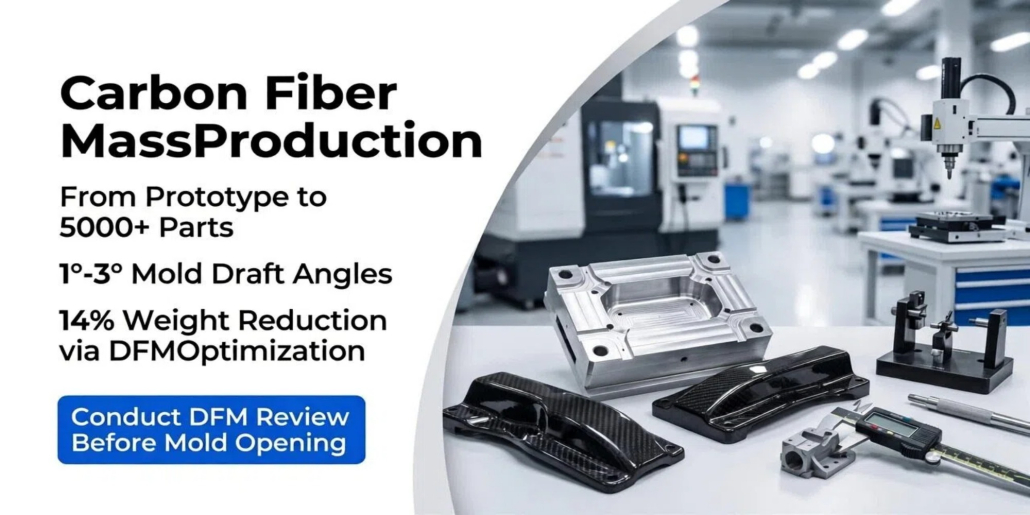
From Prototype to Mass Production: How Custom Carbon Fiber Components Are Actually Manufactured
By Qi Bing — CEO & Technical Director, Dezhou Hongjin Composite Materials Co., Ltd. Last reviewed: July 2026.
I’ve spent 10 years running composite manufacturing lines and leading a technical team of more than ten engineers at Hongjin, working directly with OEM clients in sports equipment, medical, marine, automotive, and industrial machinery. Everything below reflects what we actually see on the shop floor, including the mistakes I’ve watched cost clients money.
| Quick answer:
Moving a custom carbon fiber part from prototype to mass production comes down to four decisions: (1) fixing the geometry for composite physics before quoting, (2) validating with the cheapest tooling tier that proves the design, (3) matching autoclave or compression molding to your real volume, and (4) controlling post-processing and supply chain variables at scale. Most cost overruns trace back to skipping step one. |
1.Balancing Performance and Scale: The Realities of Carbon Fiber Manufacturing
The same email lands in my inbox every few weeks: “Our prototype worked great, but our supplier can’t get us to 5,000 units without cost or quality falling apart.” It’s the most common wall engineering and procurement teams hit when moving a carbon fiber part from bench-top success to a real production line.
Specialized components make this worse. A bracket with variable wall thickness, a housing with tight-radius corners, a structural part needing a bonded metal insert — none of that behaves like a simple flat panel. The layup, the tooling, and the cure cycle all have to change together. Miss one, and you get warped parts, hidden voids, or a quote that triples between prototype and production. Cost-efficiency is locked in during design, not discovered on the production floor. Everything below is how we make that happen in practice.
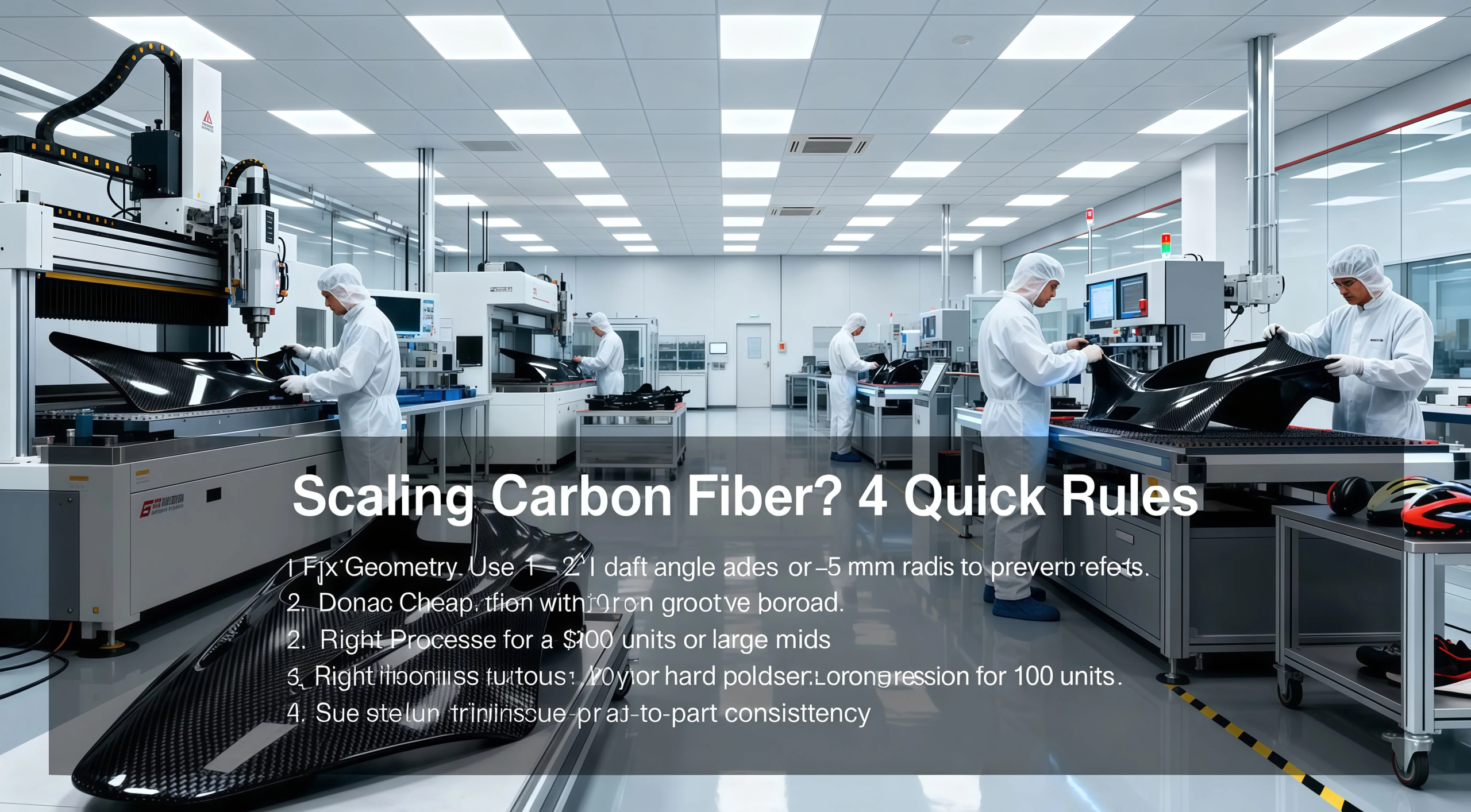
2. De-Risking the Blueprint: How We Optimize Specialized Geometries
Most CAD files we receive were designed for machining or injection molding, not composite laminates. Before anything touches a mold, we run the geometry through a design-for-manufacturing (DFM) pass, because composites break rules that metal and plastic don’t.
Draft angles. A part with vertical walls looks clean on screen, but pulling it from a mold without at least a 1° to 2° draft angle tends to tear the laminate or leave micro-fractures at the surface. On parts with internal ribs or bosses, we usually push closer to 3°.
Corner radii. Sharp internal corners are where resin pools and fiber bridges across the gap instead of following the contour — both create weak points that don’t show up until the part is under load. We hold a minimum internal radius of 3–5 mm on structural corners, more on thicker laminates.
Ply orientation. Stacking unidirectional and woven plies at 0°, ±45°, and 90° isn’t just a strength calculation — it manages cooling stress. An asymmetric layup on an asymmetric part warps coming out of the autoclave, and no post-process straightening fixes that properly.
2.1.How to Tell If Your Design Needs Rework Before You Request a Quote
These are the symptoms we look for during a DFM review, what usually causes them, and how we fix them before tooling is cut:
| Symptom in the CAD Model | Likely Root Cause | Standard Fix |
| Vertical or near-vertical side walls | Designed for CNC machining, not molding | Add 1–3° draft depending on wall height and rib density |
| Sharp 90° internal corners | Geometry copied from a metal part | Increase radius to 3–5 mm minimum; more for thick laminates |
| Sudden thickness jump at a rib or boss | No transition zone specified | Add a tapered transition to prevent resin-rich pockets |
| Non-symmetric wall thickness across the part | Load path not yet mapped to ply schedule | Re-balance ply stack around the actual load path, not the outer shape |
| Metal insert with no defined bonding land | Insert treated as an afterthought | Design a dedicated bonding shelf with defined surface prep area |
2.2.Case Study: Cutting Weight 14% on an Industrial Robotics Cover
A robotics integrator came to us with a cast-aluminum arm cover they wanted converted to carbon fiber without touching the outer envelope, since it had to fit an existing assembly. Simply mirroring the aluminum geometry in a symmetric layup would have met the shape requirement but missed the torsional load path the part actually carries in service.
We remapped the ply schedule around the real load path instead of the outer surface — biasing ±45° plies through the torsion zone and dropping unnecessary 0° plies in low-stress regions. The result: raw material weight down 14%, torsional rigidity spec passed on the first physical test, and no change to the outer envelope the client needed to preserve. The full cycle from DFM review to first article was five weeks.
3. Cost-Effective Prototyping: Validating Complex Forms Before Scaling
The second place projects get expensive is tooling. Clients under time pressure sometimes ask us to cut a production steel mold immediately — I understand the instinct, but for a specialized part that hasn’t been field-tested, it’s usually the wrong move.
We work with three tooling tiers. Matching the right one to your current volume — and validating before committing capital — saves real money:
| Tooling Type | Material / Volume | Advantages | Disadvantages |
| Rapid prototyping mold | Polyurethane/epoxy board, 1–5 units, $500–$1,500 | 周转速度快,修改成本低,是功能性现场测试的理想选择。 | 表面处理有限,经不起几次拉扯。 |
| 桥模 | CNC加工铝材,50-500件,单价3000-15000美元 | 生产代表性成品,支持早期客户样品 | 前期成本较高,如果后期发现设计缺陷,修改起来也更困难。 |
| 生产模具 | 硬化钢/因瓦合金,1000件以上,单价15000美元以上 | 规模化生产时单位成本最低,长期运行公差最小 | 前期投入巨大,切割后修改起来既慢又费钱 |
我对海外买家的建议始终如一:先在快速原型板上验证几何形状。这比制作桥式模具的成本低得多,而且可以让你在确定任何不易更改的设计之前,进行真正的功能测试——装配、组装、负载测试。
3.1.案例研究:在造成9000美元损失之前发现装配缺陷
一家船舶五金客户希望直接制作甲板支架的桥模,以便赶上船展的截止日期。我们说服他们先进行一次价值 900 美元的快速原型制作。对该原型进行功能测试后发现,支架与安装导轨的螺栓孔位间隙存在问题,而这个问题在CAD 图纸中并未显现——支架在模型中可以避开,但在实际现场使用的硬件组合中却无法避开。修改聚氨酯板只花了半天时间。如果在切割铝制桥模后才发现同样的问题,则意味着需要重新加工价值 9000 美元的模具,并且彻底错过展会截止日期。
4. 热压罐成型与压缩成型:为特殊零件选择合适的成型工艺
几何形状确定后,下一步就是决定采用哪种工艺来制造零件。很多报价都出在这里,因为热压罐成型和压缩成型解决的是不同的问题,正确的选择主要取决于产量和零件尺寸,而不是其他因素。
| 高压灭菌(预浸料) | 压缩成型(配套模具) | |
| 典型体积 | 不足100个单元 | 100+ 台 |
| 最佳部分简介 | 大型、有机或超高强度形状 | 中小型专用零件 |
| 周期 | 每个固化周期所需小时数 | 每部分 5-15 分钟 |
| 优势 | 最高的纤维体积分数和强度重量比 | 极短的周期时间和出色的尺寸重复性 |
| 缺点 | 速度慢,批量生产时单件人工成本较高。 | 纤维体积分数低于高压釜预浸料 |
| 典型应用 | 航空航天结构,大型医用台面 | 摩托车零件、汽车支架、运动装备 |
4.1.哪个流程适合您的环节?问问自己这四个问题
- 你们的年产量是多少?如果年产量在100件左右以下,即使生产周期较慢,高压釜成型通常也更经济。如果产量超过100件,压缩成型的单件成本就会迅速下降。
- 零件有多大?高压釜适用于无法放入模压机工作台的大型不规则形状零件。如果零件足够小,可以进行压制,那么在任何实际产量下,压缩成型几乎总是更快、更经济。
- 强度重量比的要求是什么?如果您追求的是绝对最高的纤维体积分数——达到航空航天级的结构性能——那么高压釜预浸料仍然是最佳选择。但大多数工业和消费品零部件并不需要达到如此高的强度。
- 这两个表面的尺寸要求有多严格?模对模压缩成型可以同时在两个表面上实现 A 级光洁度和尺寸控制;而高压釜成型通常只对一个表面贴合模具,另一个表面贴合坯料,如果两侧都与其他部件配合,这种方法就足够了。
4.2 案例研究:医用影像检查台面板用高压灭菌器
一家医疗设备制造商需要一种用于诊断成像系统的大型平板床板——这是一个小批量部件,年产量大约60台,决定性因素不仅是强度,还有X射线透射性。该床板必须具有足够的结构刚性以支撑患者体重,同时还要保持对X射线基本透明,这就排除了在受力路径上使用任何金属加固的可能性。
我们采用预浸料,通过热压罐固化工艺制造面板,并使用准各向同性铺层,以确保面板在负载下的挠度符合客户规格,同时避免局部增强会在成像中产生伪影。面板的尺寸和体积都表明不适合采用压缩成型——如此大的匹配模具成本太高,因此对于这种产量而言,热压罐固化工艺更具优势。
我们公司内部同时配备了高压釜和压缩成型设备,这样就不会因为碰巧拥有某台机器就引导客户选择合适的设备。如果您的订单量和几何形状更适合压缩成型,即使订单量比我们通常承接的订单要小,我们也会按压缩成型报价。
4.3 碳纤维材料及测试标准概览
我几乎每次与新客户首次通话时都会注意到一个问题:采购和工程团队往往没有拿到一份清晰易懂的参考资料,解释复合材料数据表上的数字究竟代表什么,或者应该要求供应商按照哪种测试标准进行报价。以下是我希望更多客户在首次询价前就能看到的参考表格。
| 参数/标准 | 典型范围或规格 | 为什么这很重要 |
| 纤维级/ ISO 10618:2004 | T300(标准模量)、T700(中等模量)、T800(高强度) | 更高等级的纤维可以提高强度重量比,但会增加成本——纤维等级的选择应根据实际载荷情况而定,而不仅仅是重量目标。 |
| 树脂体系/ ISO 14127:2024 | 环氧树脂(最常用)、乙烯基酯、酚醛树脂(防火型) | 提高耐温性、耐化学性和整体零件成本 |
| 纤维体积分数/ ISO 18185-4:2007 | 约55-65%(高压釜预浸料),约45-55%(压缩成型) | 较高的纤维含量通常会提高单位重量的强度和刚度。 |
| 固化温度/ ISO 11357-1:2023 | 大约 120–180°C,具体温度取决于工艺条件 | 影响循环时间和与固化剂兼容的模具材料 |
| 固化压力/固化过程参数 | 高压釜:约 6–7 巴;压缩:来自压机的更高夹紧压力 | 较低的孔隙率和更严格的尺寸控制来自于足够的固结压力 |
| 层压板密度/ ISO 1183-1:2025 | 约 1.5–1.6 克/立方厘米 | 密度约为钢的四分之一,体积比铝轻。 |
| 拉伸试验/ ISO 527-1:2019 | ASTM D3039 / ISO 527 | 确认层合板的面内拉伸强度和模量 |
| 弯曲试验/ ISO 14125:1998 | ASTM D790 / ISO 14125 | 标准弯曲强度检查,常见于来料质量控制报告中 |
| 层间剪切/ ISO 14130:1997 | ASTM D2344(短梁剪切) | 在层间分层风险演变为现场故障之前,应注意标记。 |
| 抗冲击性/ ISO 18352:2009 | ASTM D256 / ASTM D7136 | 适用于易受跌落、运输或使用中冲击载荷的部件 |
这些数字本身意义不大——它们只有在特定负载情况和工作周期下才有意义。但在比较不同供应商的报价时,务必询问他们的测试报告依据的是哪项标准。一份没有明确说明测试方法的规格书只能算是声明,而非验证。
5. 可扩展性、成本控制和更短的交付周期:全球 B2B 现实
一旦选定生产流程,国际买家关注的重点就会转移到流程的一致性、成本稳定性以及零部件到货速度上。这些顾虑不无道理——这也是我们从中国以外的客户那里听到最多的。
自动化后处理。边缘修整和钻孔均由多轴数控路由器完成,而非手工操作。虽然设置速度较慢,但可以消除零件间的差异,这对于客户将组件粘合或螺栓固定到装配体中至关重要。
供应链定位。我们通过成熟的区域供应集群采购碳纤维原材料和树脂,这有助于缓冲过去几年复合材料市场材料价格的波动,并在整个生产过程中保持报价的稳定性。
并行工程。模具制造在最终原型验证仍在进行时就开始,而不是等到最终验收完成后才开始切割钢材。对于海外客户而言,这种并行制造通常是缩短从采购订单到首批货物交付总周期的最重要因素。
5.1. 如何在合作前甄选碳纤维制造合作伙伴
如果您正在评估某个专业零部件项目的供应商,那么在第一次通话中值得询问以下问题——答案比任何宣传册都更有价值:
| 需要问的问题 | 一个有力的回答是什么样的? |
| 你们报价前会进行DFM审核吗?还是直接根据我的CAD文件报价? | A specific walkthrough of draft angles, radii, and ply strategy — not just a turnaround time |
| Do you own both autoclave and compression molding equipment? | Yes, with a clear explanation of when they’d recommend each for your part |
| Can you show a case study in my industry or a comparable load case? | A specific example with numbers, not a generic capabilities list |
| Is tooling fabrication concurrent with prototype approval, or sequential? | Concurrent — this is usually the biggest lead-time lever available |
| How do you control part-to-part variation at volume? | Specifics on automated trimming/drilling, not “quality control” as a vague answer |
6.Frequently Asked Questions
6.1.What factors dictate the initial setup cost for a custom carbon fiber specialized component?
Setup cost is driven almost entirely by tooling choice. A rapid prototyping board keeps initial tooling in the $500–$1,500 range, while a hardened steel production die costs more upfront but lowers per-unit cost significantly over a multi-year production run.
6.2.How does Dezhou Hongjin manage lead times for overseas B2B clients?
We keep the full process in-house — toolmaking, autoclave and compression molding, and multi-axis CNC post-processing under one roof — so parts aren’t waiting in queue at a third-party shop between steps. That’s what compresses the timeline between prototype approval and production shipment.
6.3.Can a carbon fiber component realistically replace a cast aluminum or steel part?
In most structural applications, yes. With the right ply schedule, a carbon fiber part can match or exceed the yield strength of the metal equivalent while cutting component weight by roughly 60–70%, which often drives the whole project — less weight means less strain on connected motors, bearings, or moving assemblies.
6.4.How do I know if my part needs autoclave processing instead of compression molding?
Start with volume and size. Under roughly 100 units a year, or a part too large for a matched-die press, autoclave is usually the right call. Above that volume, on a part small enough to press, compression molding will almost always be faster and cheaper.
6.5.What’s the biggest mistake companies make when scaling a carbon fiber prototype to production?
Skipping the DFM review and jumping straight to production tooling. A design flaw that costs half a day to fix on a $900 prototype board can cost weeks and thousands of dollars to fix after a steel die has already been cut.
7.Partnering for Commercial Success: Accelerate Your Production Timeline
Scaling a specialized carbon fiber component from a working prototype to a dependable production run isn’t something to hand to a build-to-print shop and hope for the best. It takes a partner who reviews the geometry before quoting, recommends the right tooling tier for your actual volume, and owns both autoclave and compression assets so the process decision is based on your part, not on what’s sitting in the factory.
如果您有想要投入生产的特殊零部件的CAD文件,请发送给我们。我们会进行DFM(面向制造的设计)审查,并提供一份清晰明了的成本和工艺建议——完全免费,只是对如何正确制造该零部件进行客观评估。
齐兵是德州宏进复合材料有限公司(carbonoem.com)的首席执行官兼技术总监,他领导着一支由 10 多名工程师组成的技术团队,为体育器材、医疗、船舶、汽车和工业机械等行业的 OEM 客户提供服务。


Leave a Reply
Want to join the discussion?Feel free to contribute!