
Carbon Fiber Beams: Reshaping the Performance Ceiling of High-Precision Equipment
When “Lightweighting” Becomes the Core Code of Equipment Evolution
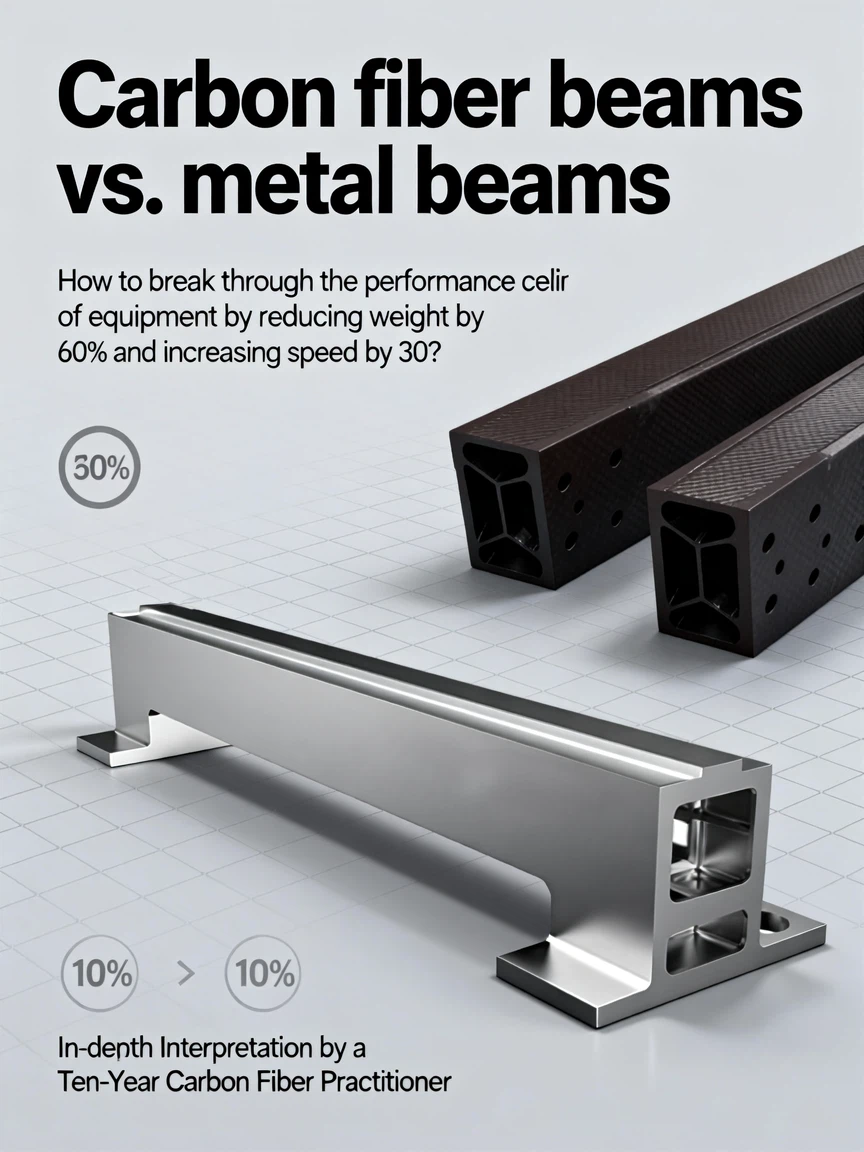
In the field of high-end manufacturing, we have been pursuing a seemingly contradictory performance goal: how to make the core structural components of equipment – such as beams and moving parts – lighter while simultaneously possessing higher rigidity and more stable performance.
Traditional materials like steel or aluminum alloys seem to have hit a performance ceiling.
As a seasoned veteran with ten years of experience in the carbon fiber industry, I have witnessed firsthand how composite materials turn this “contradiction” into reality. Today, let’s break down how high-end equipment manufacturers are positioning carbon fiber beams as a killer feature in their new products.
Table of Contents:
1.Core Advantages: One Table to See Why to Change the “Beam”
2.Technical Core: Beyond “Light,” Winning with “Stability” and “Speed”
3.Application Scenarios: Whose Equipment Needs This Upgrade Most?
4.Q&A: Tackling the Tough Question: High Cost? Is It Really Worth It?
5.The Future is Here, Just Not Yet Widespread
1.Core Advantages: One Table to See Why to Change the “Beam”
Talk is cheap; data speaks. The table below intuitively compares the core performance differences between carbon fiber composite beams and traditional materials.
| Performance Indicator | Carbon Fiber Composite Beam | Traditional Steel Beam | Traditional Aluminum Beam | Direct Benefit for Equipment |
| Weight | Extremely Light (60% lighter than steel, 30% lighter than aluminum) | Heavy | Relatively Light | High Acceleration, Low Inertia: Moving parts start/stop faster, reducing cycle time and directly boosting production efficiency. |
| Specific Stiffness (Stiffness/Density) | Extremely High | Low | Medium | High Precision, No Chatter: Excellent resistance to deformation, ensures trajectory accuracy during high-speed movement, improving machining/measurement quality. |
| Coefficient of Thermal Expansion | Extremely Low (Nearly Zero) | High | Relatively High | High Thermal Stability: Minimal impact on precision from ambient temperature fluctuations, ensuring long-term operational stability. |
| Damping Characteristics | Excellent | Poor | Fair | Vibration and Noise Reduction: High internal damping quickly absorbs vibrations, resulting in smoother equipment operation and higher surface finish quality. |
Key Insight:
The core of this table lies in “Specific Stiffness.” Everyone understands lightweighting, but the true killer advantage of carbon fiber is its exceptional rigidity relative to its light weight.
This means your machine tools, laser cutters, or measuring equipment can pursue speed without sacrificing precision.
2.Technical Core: Beyond “Light,” Winning with “Stability” and “Speed”.
Customized Layup Design:
Like “tailoring” the beam, computer simulations optimize the direction and sequence of carbon fiber tows based on stress analysis, maximizing stiffness.
Advanced Molding Processes:
Utilizing processes like molding and winding ensures full resin infiltration and zero internal defects, guaranteeing product consistency and reliability.
3.Application Scenarios: Whose Equipment Needs This Upgrade Most?
3.1 High-Precision Machine Tools and Laser Cutting Machines: For manufacturers seeking ultimate dynamic accuracy and efficiency.
3.2 Industrial Robots/Automation Arms: Especially robots used in automotive manufacturing and precision electronics assembly, where weight reduction directly increases speed and accuracy.
3.3 Precision Measuring Equipment (CMM): Where any micron-level deformation is unacceptable, making thermal stability paramount.
3.4 Medical and Scientific Equipment (MRI, CT, Accelerators): For special scenarios requiring non-magnetic properties, high rigidity, and light weight.
4.Tackling the Tough Question: High Cost? Is It Really Worth It?
Question: “I know carbon fiber beams are good, but the price is significantly higher than traditional metals. How can I determine if this upgrade is truly ‘cost-effective’ for my equipment?”
Answer: This is a very practical and crucial question.
My suggestion is not to look solely at the procurement cost of the single component, but to calculate the Total Cost of Ownership (TCO) and the Return on Performance.
Efficiency Gain Equals Profit:
If upgrading the beam increases your machining center’s speed by 20%, it means more products are output per unit time.
The incremental material cost might just be a “small fraction” when amortized.
Quality Premium: Higher precision and stability directly lead to better yield rates, reducing costs associated with scrap and rework. In a competitive market, product quality is your leverage.
Reduced Energy Consumption: Driving lighter moving parts reduces motor load, saving considerable electricity costs in the long run.
Long-Term Competitiveness: When your competitors are still using metal beams, your equipment possesses superior performance due to the core component upgrade. This in itself is a powerful market selling point.
In short, if your business core relies on the precision, speed, and reliability of your equipment, then a carbon fiber beam is not a “cost,” but a highly profitable “investment.”
5.The Future is Here, Just Not Yet Widespread
The application of carbon fiber composites in industrial equipment is no longer “black technology” but a mature solution validated by the market. It is steadily moving down from high-end fields like aerospace to high-value-added industrial manufacturing. As practitioners, our task is to promote this “beam revolution,” enabling more equipment to break through performance bottlenecks. The future is here; the key lies in whether you can seize the opportunity.


Leave a Reply
Want to join the discussion?Feel free to contribute!