
Carbon Fiber Pressure Vessels and Complex-Shaped Parts: Injection Molding vs. Hot-Press Molding, Explained by a Manufacturer
By Qi Bing, Founder, Dezhou Hongjin Composite Materials Co., Ltd. (carbonoem.com)
10 years in carbon fiber manufacturing | Shandong, China | Full-chain R&D, production, and equipment supply
| Quick Answer
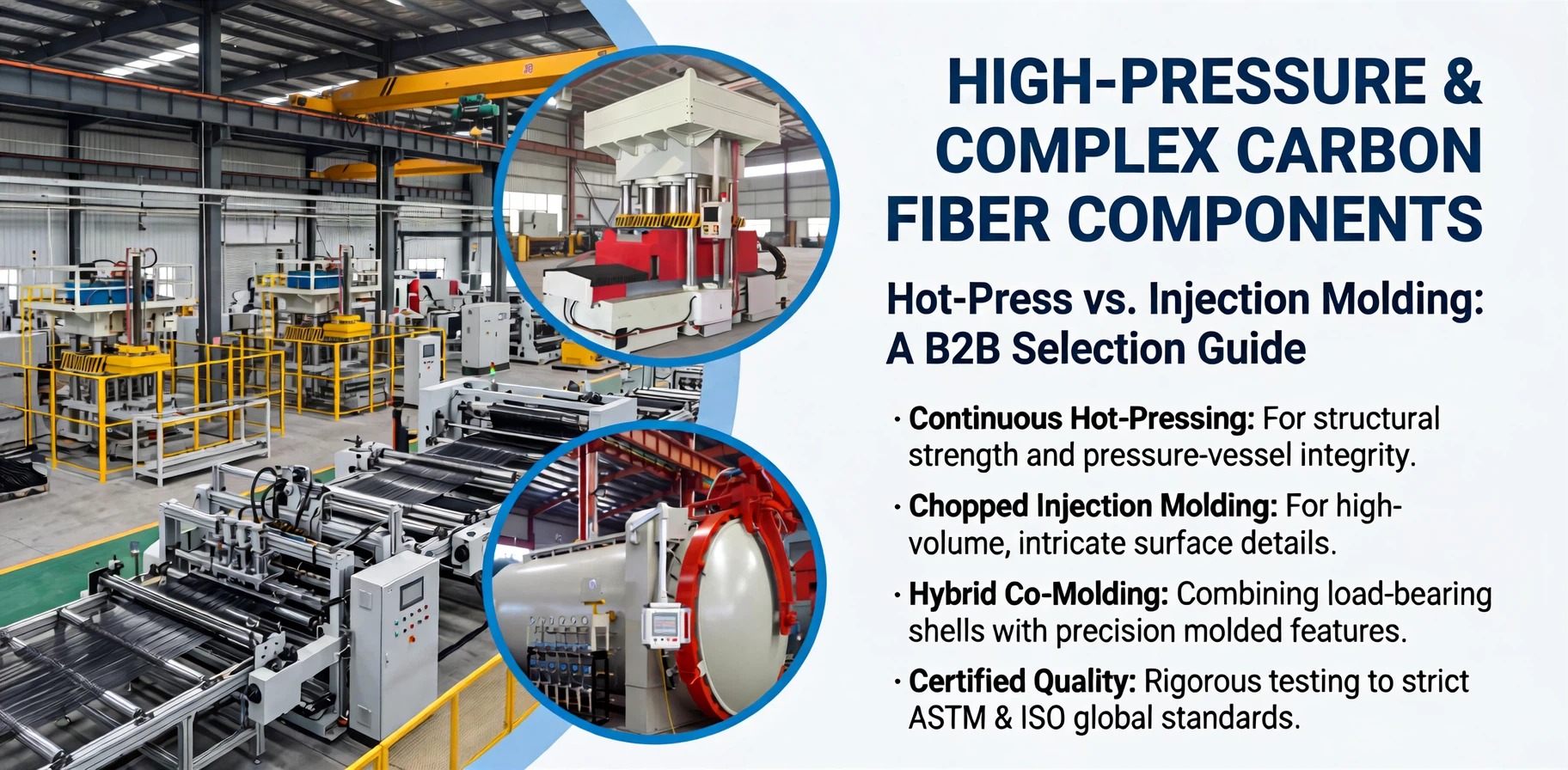
For pressure vessels and structurally loaded complex parts, continuous-fiber hot-press (compression) molding is the right process — it gives directional strength that chopped-fiber injection molding cannot match. Injection molding wins on parts with deep ribs, bosses, and thin snap-fit features that don’t carry serious load, especially above 10,000 units a year. Many real-world housings end up as a hybrid of both. |
I get a version of this question almost every month, usually with a 3D file attached: a client wants a curved housing, a small pressure vessel, or a bracket with a dozen ribs and bosses, and they ask whether we can “just injection mold it.” The honest answer is usually no — not if the part needs to hold pressure or carry real load — but explaining why takes more than one sentence, so I wrote this out properly.
This is a companion piece to our earlier post, From Prototype to Mass Production, which covers process selection across a project’s full volume curve. Here I want to zoom into one specific fork in the road: injection molding versus hot-press molding for parts that are either pressure-rated, geometrically complex, or both.
1.Why This Decision Matters More Than It Looks
Get this call wrong in one direction and you overpay — steel injection tooling for 2,000 units a year rarely earns its cost back. Get it wrong in the other direction and the part underperforms in service: chopped fiber simply cannot carry the directional load a pressure vessel wall needs, no matter how thick you mold it. I’ve seen both mistakes on our own quoting desk, usually from buyers whose CAD software could render the part but whose spec sheet never mentioned the load case.
2.Two Processes, One Confusing Overlap
Injection molding and hot-press molding both use heat, pressure, and a mold, which is exactly why buyers new to composites conflate them. The fiber tells the real story.
2.1Chopped-fiber injection molding
Short carbon fiber, usually 0.2–12.7 mm long, is compounded into a thermoplastic pellet — nylon, PPS, or PEEK are common — and shot into a mold on a standard injection molding machine. Fiber orientation follows the melt flow, not the engineer’s intent, and fiber loading typically sits at 15–40% by weight. It is fast (30–90 second cycles) and excellent at ribs, bosses, and thin walls, but the resulting strength is closer to a reinforced plastic than a structural composite.
2.2Continuous-fiber hot-press molding
This is our core process. Woven fabric or unidirectional prepreg is laid into a matched-metal mold, ply by ply, in a stacking sequence an engineer specifies for the actual load path, then cured under heat and pressure in a hydraulic press. Fiber content runs 50–65% by volume, and because the fiber direction is controlled rather than left to chance, the strength and stiffness are an order of magnitude higher in the loaded direction. This is what we use for pressure-vessel shells, structural brackets, and other load-bearing housings.
3.Advantages and Limitations, Side by Side
| Process | Advantages | Limitations |
| Injection molding (chopped fiber) | Fast cycles (30–90 sec); handles ribs, bosses, undercuts natively; low labor cost at volume | Weaker, non-directional strength; not pressure-vessel capable; high tooling cost only pays off above ~10,000 units/yr |
| Hot-press molding (continuous fiber) | High, directional strength; pressure-vessel and structural capable; moderate tooling cost | Slower cycles (10–45 min cure); struggles with sharp internal ribs/undercuts; more labor-intensive layup |
4.Full Technical Comparison
| Parameter | Injection Molding | Hot-Press Molding |
| Fiber form | Chopped, randomly oriented | Continuous woven / UD prepreg |
| Typical fiber content | 15–40 wt% | 50–65 vol% |
| Tensile strength (typical) | 80–180 MPa | 400–1,200 MPa, direction-dependent |
| Design freedom (ribs, bosses) | Excellent | Limited without secondary work |
| Tooling cost | Higher (steel mold, hot runner) | Moderate (aluminum or steel matched mold) |
| Cycle time | 30–90 seconds | 10–45 minutes |
| Economic volume | 10,000+ units/year | 50–10,000 units/year |
| Pressure rating | Non- to semi-structural | Structural, pressure-vessel capable |
5.How We Actually Make the Call
There’s no flowchart that replaces judgment here, but three factors decide most quotes on our desk.
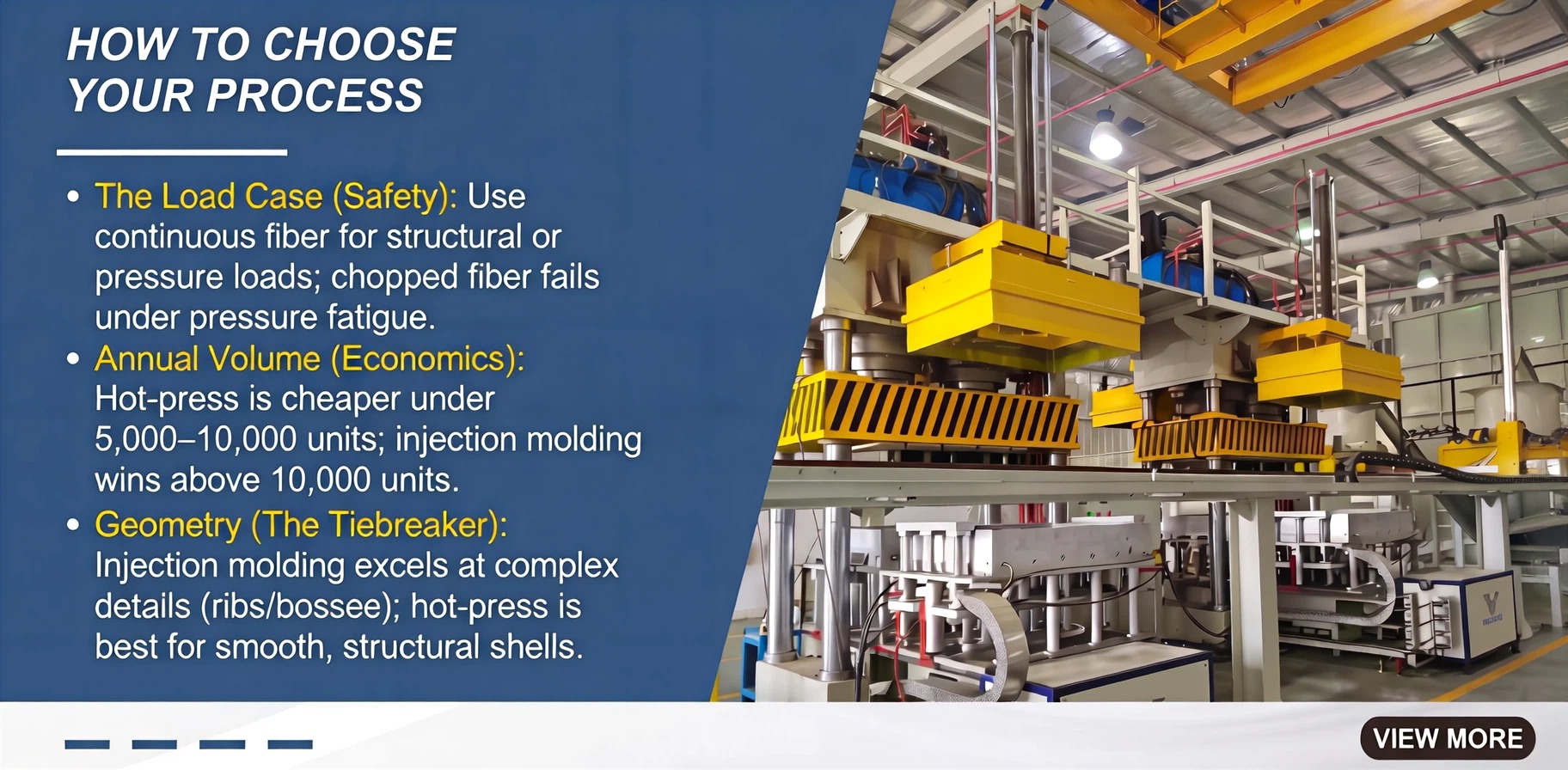
Load case comes first: if the part holds internal pressure or carries meaningful bending or torsional load — a vessel, a structural bracket, anything safety-critical — we start from continuous fiber, full stop. Chopped fiber’s random orientation can’t be trusted under a repeated pressure cycle the way a properly laid-up shell can.
Volume comes second, and it’s more of a threshold than most buyers expect: Injection tooling is expensive to cut, so below roughly 5,000–10,000 units a year the amortized tooling cost per part usually exceeds what you’d pay in hot-press labor instead. Above that line, a 60-second cycle time starts winning on raw economics regardless of the geometry.
Geometry is the tiebreaker, and it cuts both ways: Deep ribs, snap-fit bosses, and variable wall thickness are genuinely difficult to laminate — woven fabric wrinkles or bridges across sharp internal corners, which is exactly where injection molding is in its element. A smooth vessel shell or a flat bracket, on the other hand, is precisely the shape hot pressing handles best. A part that looks “complex” on a rendering isn’t automatically an injection-molding candidate; what matters is whether the complexity lives in the load path or in the surface detail.
6.An Illustrative Case: A Hybrid Build for a Marine Sensor Housing
The project below is a composite of the kind of work we see regularly, written to show how the decision plays out — not one client’s proprietary data.
A marine electronics buyer needed a housing that had to hold a modest internal pressure differential at depth, carry six mounting bosses plus a cable-gland boss, and ship at around 3,000 units a year. Neither process alone was a clean fit. Continuous fiber alone meant the bosses would need heavy secondary machining after cure; chopped-fiber injection molding alone couldn’t meet the pressure rating.
We hot-pressed the pressure-bearing shell in-house from woven prepreg to meet the structural requirement, then coordinated the boss features as a lower-pressure overmolded step with a qualified thermoplastics partner, keyed into the cured shell geometry we supplied. Total tooling cost stayed close to a single hot-press mold, and first article shipped roughly five weeks after tooling sign-off.
The takeaway I give buyers: for genuinely complex parts, the question usually isn’t “which process,” it’s which features actually need continuous fiber and which don’t.
7.Mistakes We See Most Often From Overseas Buyers
| Symptom | Likely Cause | Fix |
| Part passes a static load test but fails later in fatigue | Structural feature was specified in chopped-fiber injection molding | Re-spec the load-bearing region in continuous fiber, or hybridize |
| Quoted tooling cost is far higher than expected | Low annual volume run through injection-molding economics | Move to hot-press molding, or use bridge tooling under ~5,000 units/yr |
| Hot-pressed part shows wrinkling near ribs or bosses | Continuous fabric forced into injection-style geometry | Redesign as a hybrid, or machine/bond the feature separately |
| Injection-molded boss cracks under vibration | Chopped-fiber orientation is weak in that specific load direction | Add a local continuous-fiber insert, or relocate the boss to the hot-pressed section |
8.Standards We Test Against
| Standard | What It Covers | Why It Matters Here |
| ASTM D3039 | Tensile properties of polymer matrix composites | Verifies in-plane strength of hot-pressed laminates |
| ASTM D790 | Flexural properties, 3-point bending | Confirms bending stiffness for both processes |
| ASTM D2344 | Short-beam shear strength | Checks interlaminar bond quality in hot-pressed parts |
| ASTM D7136 | Damage resistance, drop-weight impact | Impact tolerance for structural housings |
| ISO 527 / ISO 14125 | Tensile and flexural properties of plastics/FRP | Baseline data for cross-checking injection-molded compounds |
9.Frequently Asked Questions
9.1Can a carbon fiber pressure vessel be injection molded?
Not reliably, in our experience. Random fiber orientation in an injection-molded shell can’t consistently meet burst-pressure and fatigue requirements. We hot-press vessel shells with an engineered ply layup specifically because the load path is predictable and the fiber runs where the stress actually is.
9.2Can one part combine both processes?
Yes. Hybrid builds — a hot-pressed structural shell with injection-molded or overmolded local features — are common for parts that need both pressure performance and fine detail. The marine housing example above is a typical case.
9.3Which process costs less per part?
It depends almost entirely on volume, not on which process is “better.” Injection molding’s steel tooling is expensive to cut but amortizes quickly at high volume; hot pressing has lower tooling cost but more labor per part, so it stays competitive from prototype quantities up to roughly 10,000 units a year.
9.4What information do you need to recommend a process?
Send the loading conditions (pressure rating, static or dynamic loads, required safety factor), your target annual volume, and the CAD model together. We typically come back with a process recommendation and a rough tooling estimate within 2–3 business days.
Dezhou Hongjin Composite Materials Co., Ltd. is an OEM carbon fiber manufacturer in Shandong, China, specializing in continuous-fiber hot-press and compression molding for sports equipment, medical, marine, automotive, and industrial machinery clients worldwide. See our custom carbon fiber components or carbon fiber plate capabilities, or read more about our team. To discuss which process fits your part, request a quote.


Leave a Reply
Want to join the discussion?Feel free to contribute!